



The Cosmic CSI Unit
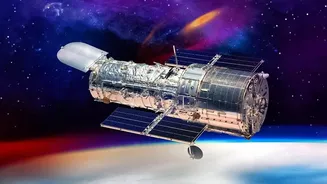
Imagine trying to figure out the ingredients of a cake by only looking at its shadow. That’s a simplified version of what space telescopes like the James Webb Space Telescope (JWST) do. The primary technique they use is called transmission spectroscopy.
When a distant planet, or exoplanet, passes in front of its host star from our point of view—an event called a transit—a tiny fraction of the starlight filters through the planet's atmosphere. This is the crucial moment. Just as a prism splits white light into a rainbow, specialized instruments on the telescope split this filtered starlight into a detailed spectrum of colours.
Reading the Barcode of an Atmosphere
Every gas and molecule has a unique chemical fingerprint. When starlight passes through an atmosphere, molecules like water, carbon dioxide, and methane absorb very specific wavelengths, or colours, of that light. This creates a pattern of dark lines in the star's light spectrum, like a barcode. The telescope's sensors are designed to read this barcode with incredible precision. By identifying which specific wavelengths are missing from the starlight after it has passed through the planet's atmosphere, scientists can determine exactly what molecules are present. A dip in the light at a certain infrared wavelength points directly to the presence of methane.
Meet the 'Warm Neptunes'
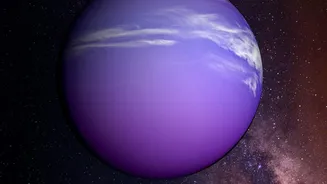
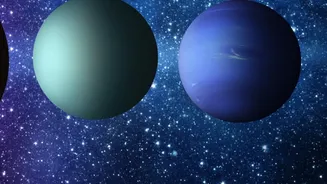
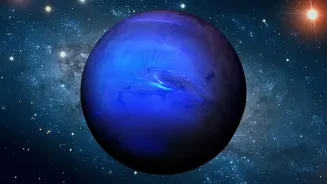
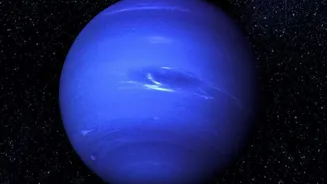
The targets for this cosmic investigation are often planets like 'Warm Neptunes'. These are gas giants similar in size to our own Neptune or Uranus, but they orbit much closer to their star, making them warmer than our local ice giants. Their proximity to their star means they transit more frequently, giving astronomers more opportunities to study them. Planets like WASP-80 b and TOI-199b have become key subjects for this kind of atmospheric study. Because they are cooler than the scorching 'Hot Jupiters', their atmospheres are more likely to have complex chemistry where molecules like methane can exist without being immediately destroyed.
The Search for Methane
Detecting methane is a significant achievement. Until the launch of the JWST, methane had been surprisingly elusive in exoplanet atmospheres, even where it was expected to be abundant. On Earth, the vast majority of methane is produced by life, which makes it a tantalizing potential 'biosignature' in the search for extraterrestrial life. However, methane can also be produced by non-biological processes, so its presence alone isn't proof of life. But because methane breaks down relatively quickly when exposed to starlight, finding a lot of it in an atmosphere implies that something is actively replenishing it. This makes any planet with a strong methane signature a high-priority target for further investigation.
Beyond Biosignatures
While the search for life gets the headlines, detecting methane also provides crucial clues about a planet's history. By measuring the amounts of methane and water, scientists can infer the ratio of carbon to oxygen atoms in the atmosphere. This ratio can help them understand where and how the planet originally formed in its solar system—whether it formed close to its star or farther out before migrating inward. This allows for an 'apples-to-apples' comparison with planets in our own solar system, refining our universal models of planet formation. Each detection helps build a more complete picture of the diverse ways planets and their atmospheres evolve across the galaxy.