




A New Trick for a Veteran Planet Hunter
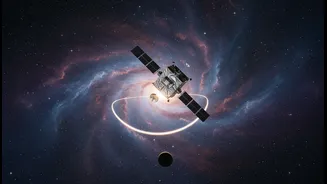
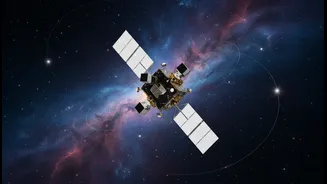
NASA’s Transiting Exoplanet Survey Satellite, or TESS, is a celebrated planet hunter. Since its launch in 2018, it has confirmed hundreds of new worlds and identified thousands more candidates. Its primary method is brilliantly simple: TESS stares at stars
and waits for a tiny, periodic dip in their brightness. This dip, called a transit, often signals a planet passing in front of its star from our perspective. This technique is fantastic for finding large planets orbiting very close to their stars. But recently, astronomers used TESS for something it was never designed to do, catching a planet through a method that relies on one of Albert Einstein's most profound predictions. It’s a technique that doesn't look for dimming starlight, but for a sudden brightening.
Using Gravity as a Magnifying Glass
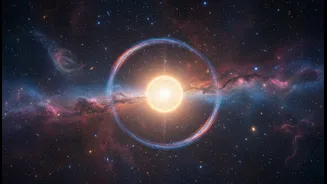
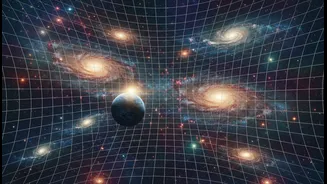
The discovery hinges on a phenomenon called gravitational microlensing. According to Einstein's theory of general relativity, massive objects warp the very fabric of space and time around them. We perceive this curvature as gravity. This warping effect means that light from a distant object will bend as it passes by a massive object in the foreground. If the alignment is just right, the foreground object—like a star or even a planet—acts as a natural magnifying lens, briefly amplifying the light of a star behind it. Astronomers recently spotted just such an event. First flagged by the European Space Agency's Gaia mission in 2023, a star 40,000 light-years away suddenly appeared brighter. By digging through archived data, researchers realised TESS had also been watching, capturing the event in much greater detail. Its observations revealed a second, smaller flicker in the light, the tell-tale signature of a planet adding its own small gravitational lens to the mix.
Meet Gaia23bra b
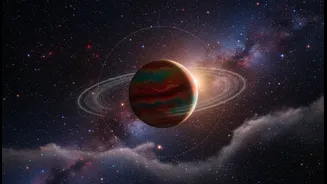
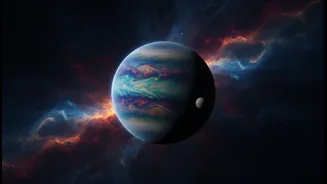
The newly confirmed planet, named Gaia23bra b, is a behemoth about 1.6 times the mass of Jupiter. It orbits an orange dwarf star, smaller than our sun, at a distance similar to Jupiter's own orbit. What makes this discovery so remarkable is that the planet and its star are 40,000 light-years away, far beyond TESS's usual hunting ground of about 150 light-years. The planet was completely invisible to direct detection. It was found not by seeing it, but by seeing its gravity at work. The microlensing event was a one-time celestial alignment; the systems have since moved on and it won't be repeated. But for a brief moment, the planet's gravity bent spacetime just enough to make its presence known across an immense cosmic distance, a tangible demonstration of this powerful force.
A New Frontier for TESS
This marks the first time TESS has confirmed a planet using gravitational microlensing, a technique that was not part of its original mission plan. Scientists are excited because it opens a new avenue for discovery. While the transit method TESS typically uses is responsible for finding about 75% of all known exoplanets, microlensing can find worlds that transits miss, particularly those in wide, solar-system-like orbits. The discovery suggests that there are likely other planets hiding in TESS's vast archives, waiting to be found by astronomers who now know to look for this gravitational signature. It highlights how combining data from different telescopes, like Gaia and TESS, can lead to breakthroughs that neither could achieve alone.