




Sailing on a Beam of Light
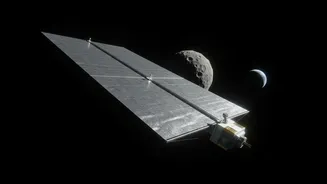
Imagine a sailboat, but instead of a canvas sail catching the wind, it has a vast, ultra-thin, mirror-like sheet that catches sunlight. This is the core concept of a solar sail. These sails are made from incredibly lightweight, reflective materials, sometimes
thinner than a human hair, stretched out over a massive area. Unlike conventional rockets that rely on heavy, finite fuel supplies, a solar sail has a virtually limitless source of propulsion: the sun itself. This elegant method of travel has moved from the pages of science fiction, first imagined by scientists in the 1920s, to a proven technology being tested and deployed on real space missions.
The Gentle Push of Photon Pressure
So, how can light, which has no mass, push a spacecraft? The answer lies in a phenomenon called radiation pressure. Light is made of particles called photons. While they are massless, photons possess momentum. When billions of these photons stream from the sun and strike the reflective surface of a solar sail, they bounce off. In that moment of reflection, they transfer a tiny bit of their momentum to the sail, giving it a gentle but continuous push. The force from a single photon is minuscule, but in the frictionless vacuum of space, the constant barrage of photons adds up. Over time, this unrelenting pressure allows the spacecraft to build up tremendous speed, potentially faster than what conventional rockets can achieve over long durations.
Navigating the Cosmos with Precision
A solar sail isn't just about moving in a straight line away from the sun. By carefully tilting the sail, operators can change the angle at which sunlight reflects. This acts like a ship's rudder, allowing them to steer the spacecraft and fine-tune its trajectory. By angling the sail, the push from the photons can be directed to either speed up, slow down, or change the spacecraft's orbit around the sun. This ability to navigate without fuel is a breakthrough for low-cost, long-duration missions. Recent advancements focus on creating lighter, more durable composite materials for the booms that deploy these massive sails, ensuring they can be packed into tiny satellites, called CubeSats, and unfurl reliably in space.
The Ideal Tool for Asteroid Rendezvous
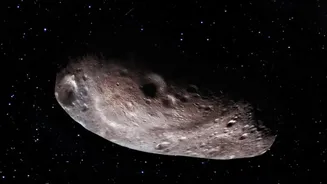
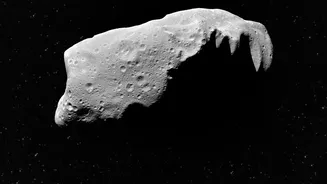
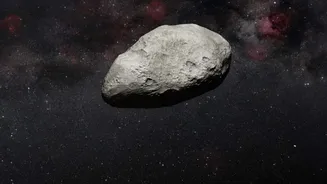
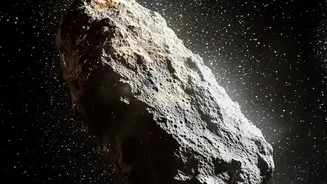
This technology is uniquely suited for studying near-Earth asteroids (NEAs). These asteroids are ancient remnants from the formation of our solar system, and studying them provides invaluable scientific insight. However, they are often small and have very weak gravitational fields, making it difficult for traditional, high-speed spacecraft to enter orbit or perform slow flybys. Solar sails solve this problem. Their low-thrust, continuous propulsion is perfect for making the delicate, precise maneuvers needed to approach and observe these small bodies up close. A mission can slowly and carefully match the speed of an asteroid, allowing for hours of observation instead of a fleeting glimpse.
Missions Putting the Theory to Practice
NASA has been a key developer of this technology. One notable mission was the Near-Earth Asteroid Scout (NEA Scout), which launched aboard the Artemis I mission in 2022. Housed in a spacecraft the size of a shoebox, its goal was to deploy an 86-square-meter sail and travel to the smallest asteroid ever to be studied. Unfortunately, contact with NEA Scout was lost after its deployment, so the mission could not be completed. However, the project built upon the success of earlier demonstrations like The Planetary Society's LightSail program and laid the groundwork for future systems. Ongoing projects like NASA's Advanced Composite Solar Sail System (ACS3) and the larger Solar Cruiser concept are testing new materials and deployment mechanisms for even bigger and more capable sails, proving the commitment to this futuristic propulsion system.