





Why October Is a Great Month
Timing is everything in stargazing, and October 2026 is an excellent window for spotting Saturn. The planet reached 'opposition' in early September, an event where Earth passes directly between the sun and Saturn. This means Saturn is relatively close
to us in its orbit, causing it to appear at its biggest and brightest in our sky. While the peak has passed, the planet remains a brilliant object throughout October, visible for most of the night. It rises in the southeast during the late afternoon and climbs high into the southern sky through the evening, making it a convenient target for after-dinner observation.
What You're Looking For
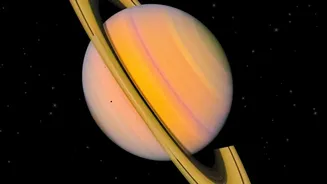
Before you start your search, it helps to know your target. To the naked eye, Saturn will not look like the ringed jewel you see in NASA photos. Instead, it will appear as a bright 'star'. The key differentiator is its light. Stars, being incredibly distant, have their light disturbed by Earth's atmosphere, which causes them to twinkle. Planets in our solar system are much closer, so their light appears as a steadier, more solid glow. Look for a bright, yellowish-white point of light that isn't twinkling. That steady, serene glow is a strong sign you are looking at a planet, and this month, that planet is likely Saturn.
The Classic Method: Star Charts
Using a star chart, or a planisphere (a rotating star map), is the traditional way to navigate the night sky. First, you need to orient yourself. Use a compass app on your phone to find which way is south. In October, Saturn will be located in the constellation Aquarius. This constellation can be faint and tricky for beginners to spot on its own. A better technique is 'star hopping'. Look for a more prominent pattern, like the Great Square of Pegasus, a large box of four bright stars that will be high in the southeastern sky during the evening. Aquarius is located just below and to the south of this square. Using your chart, you can trace a path from these brighter guidepost stars to the area where Saturn is predicted to be. Find that steady, golden light in the region, and you've found your planet.
The Easy Way: Basic Astronomy Apps
For a truly foolproof method, let your smartphone be your guide. Modern astronomy apps have made planet-finding incredibly simple. Apps like SkyView Lite, Star Walk 2, or Stellarium Mobile use your phone’s built-in GPS and compass to generate a real-time map of the sky. You don't need to know constellations or directions. Simply download one of these apps (many have free versions), give it permission to use your location, and point your phone at the sky. The screen will show you an augmented-reality view of the stars, planets, and constellations in that exact direction. You can use the search function to type 'Saturn', and an arrow will guide you to its precise location. It’s an empowering tool that feels like having an astronomer in your pocket.
Setting Yourself Up for Success
Your viewing experience depends heavily on your environment. The most important factor is a clear, dark sky. City lights create 'light pollution' that washes out fainter stars and makes celestial objects harder to see. If possible, find a spot away from direct streetlights or building lights, like a local park or even a darker corner of your own garden. Give your eyes about 20 minutes to fully adapt to the darkness; this will dramatically increase how much you can see. Also, check the weather forecast before you head out. A sky full of clouds is an obvious showstopper. Finally, bring a red-light torch if you have one. Red light is less disruptive to your night vision than the white light from a standard torch or your phone screen, which can be useful for reading a paper star chart.
Taking a Closer Look
While Saturn is a fantastic sight for the naked eye, even a little magnification can enhance the view. A standard pair of binoculars will help stabilise the image and make its yellowish colour more apparent. But the real magic happens with a telescope. You don’t need a giant observatory-grade instrument to see Saturn’s most famous feature. Even a modest beginner's telescope with around 50x magnification will be able to resolve the planet from a point of light into a distinct orb, with its breathtaking rings clearly visible. Seeing them for the first time with your own eyes is an unforgettable experience that can easily spark a lifelong passion for astronomy.