


What Exactly is a Solar Sail?
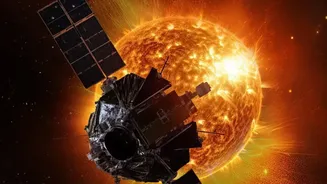
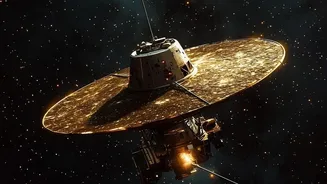
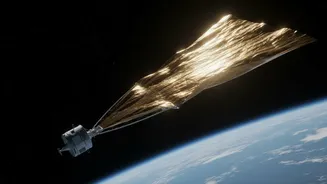
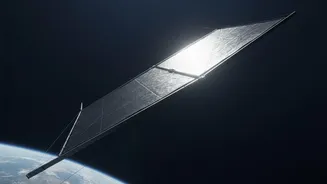
A solar sail is a form of spacecraft propulsion that works without any rocket fuel. Think of it like a sailboat on the ocean, but instead of wind, it catches light. These spacecraft unfurl massive, ultra-thin, mirror-like sails, some as large as a small
apartment or half a tennis court. The purpose of this giant mirror isn't to look at anything, but to capture the momentum from sunlight to push the spacecraft forward. It’s a technology that relies on a constant, gentle push, differing greatly from the powerful, short bursts of chemical rockets. While the idea has been around for centuries, recent test missions are finally proving its viability for modern space exploration.
The Physics of Sailing on Light
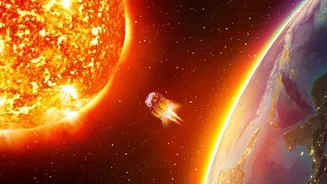
So, how can light, which has no mass, push something as large as a spacecraft? The secret lies in momentum. Light travels as particles called photons. While photons are massless, they have momentum as they travel through space. When these countless photons strike the highly reflective surface of a solar sail, they bounce off. As each photon reflects, it transfers a tiny amount of its momentum to the sail, giving it a minuscule push. While a single push is incredibly slight, the constant stream of photons from the sun provides a continuous, unending force. In the vacuum of space, with no friction to slow it down, these tiny pushes add up, allowing the spacecraft to steadily accelerate and, over time, reach immense speeds.
The Continuous Boost Advantage
The key difference between solar sails and conventional rockets is fuel. A rocket carries all its propellant onboard and burns through it in powerful, brief maneuvers. Once the fuel is gone, its major acceleration is over. A solar sail, however, uses an inexhaustible fuel source: sunlight. This allows for continuous, low-level acceleration. While it starts much slower than a rocket, it never stops speeding up as long as it's exposed to light. Over weeks, months, and years, a solar sail-powered craft can theoretically reach higher top speeds than a chemical rocket, making it one of the few technologies currently feasible for interstellar travel. This fuel-free model promises to make long-duration missions more affordable and sustainable.
Putting the Sails to the Test
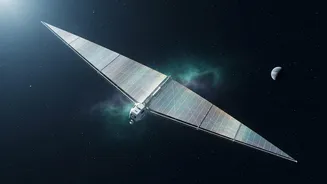
Several key missions have demonstrated the potential of solar sailing. Japan's IKAROS, launched in 2010, was the first craft to successfully use a solar sail for propulsion in interplanetary space. More recently, The Planetary Society's crowdfunded LightSail 2 mission, which flew from 2019 to 2022, proved that a small satellite could successfully use sunlight to change its orbit around Earth. Building on this success, NASA launched the Advanced Composite Solar Sail System (ACS3) in April 2024. The goal of ACS3 is to test new lightweight but rigid booms made of composite materials, which are crucial for deploying the much larger sails needed for future deep-space missions. Though the ACS3 mission encountered a slight bend in one of its booms during deployment, it has been a critical test for these next-generation materials.
Challenges and the Future of Spaceflight
Despite its promise, solar sailing faces engineering hurdles. The sails must be incredibly large, lightweight, yet durable enough to withstand the space environment. Deploying these delicate, gossamer-thin structures without tearing or tangling is a high-risk maneuver. Furthermore, controlling the spacecraft's attitude and direction by tilting the massive sail requires extreme precision. However, overcoming these challenges could unlock a new era of space exploration. Future applications include maintaining satellites in unique orbits without using propellant, de-orbiting space junk, and powering probes on long journeys to the outer solar system and beyond. With successful tests of new materials like the composite booms on ACS3, sails could one day reach sizes up to 2,000 square meters, opening up previously inaccessible destinations in our solar system.