





The Sun’s Turbulent Temper
Our sun is not the perfectly calm, steady star it might appear to be. It has a dynamic and often violent nature, driven by its powerful magnetic fields. Occasionally, it unleashes enormous bursts of energy and matter known as solar flares and coronal
mass ejections (CMEs). A solar flare is an intense flash of radiation, while a CME is a massive cloud of magnetised plasma hurled into space. When these events are directed at Earth, they can cause what is known as a geomagnetic storm, a major disturbance of our planet's magnetic field and upper atmosphere. We are currently in an active phase of the sun's roughly 11-year cycle, known as the solar maximum, meaning these events are becoming more frequent.
Satellites Under Siege
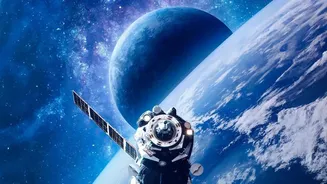
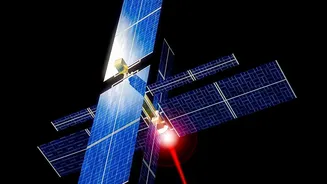
For the thousands of satellites orbiting Earth, a geomagnetic storm is a multi-pronged assault. The surge of energy heats and expands Earth's upper atmosphere, increasing the atmospheric drag on satellites in low-Earth orbit. This can slow them down, causing their orbits to decay and even leading to them falling back to Earth and burning up, as happened to dozens of newly launched Starlink satellites in 2022. At the same time, high-energy particles can bombard a satellite's sensitive electronics, causing malfunctions, 'phantom commands', or even permanent damage. This radiation also degrades solar panels, reducing a satellite's lifespan and power. Finally, the storm can disrupt the very radio signals satellites use to communicate with the ground, interfering with GPS navigation, television broadcasts, and mobile phone services.
India's Stake in Space Weather
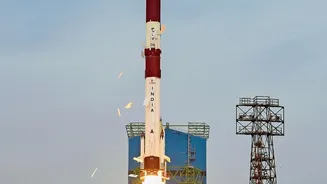
As a nation rapidly expanding its digital economy and space infrastructure, India has a significant stake in understanding and mitigating the effects of space weather. The country operates over 50 satellites for communication, navigation, weather forecasting, and defence. Systems like NavIC, India's own regional navigation satellite system, are crucial for transportation, logistics, and national security. A severe solar storm could disrupt these vital services, impacting everything from air traffic control and military operations to financial transactions and disaster management. Recognizing this, the Indian Space Research Organisation (ISRO) is actively monitoring solar activity. India's Aditya-L1 mission, the country's first dedicated solar observatory, provides a frontline view of solar eruptions, giving scientists critical data to improve forecasts and protect our assets in space.
The Quest for Better Forecasts
The key to protecting our satellite infrastructure is better forecasting. Just like predicting a cyclone on Earth, accurately forecasting a solar storm's arrival and intensity gives operators crucial time to prepare. Researchers around the world are developing new models, often using artificial intelligence and machine learning, to analyse data from solar observatories and predict when a threatening CME might hit Earth. Missions like ISRO's Aditya-L1 and NASA's fleet of solar-observing spacecraft provide a continuous stream of data on the sun's magnetic fields and radiation output. This allows space weather prediction centres to issue warnings, giving satellite operators anywhere from hours to days of lead time to take protective measures.
From Prediction to Protection
With an accurate forecast in hand, satellite operators are not helpless. They can take several steps to weather the storm. A common strategy is to put the spacecraft into a 'safe mode', temporarily shutting down non-essential and sensitive electronic systems to prevent them from being fried by charged particles. They can also reorient the satellite to present a smaller profile, reducing drag, or use onboard thrusters to adjust its orbit and counteract the effects of atmospheric expansion. Looking further ahead, more ambitious solutions are being explored. One new concept, dubbed 'StormWall', proposes a fleet of satellites that could release a cloud of ionised gas to create a temporary, artificial shield to deflect the worst of a solar storm's energy, potentially reducing its impact by half.