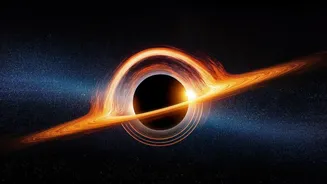







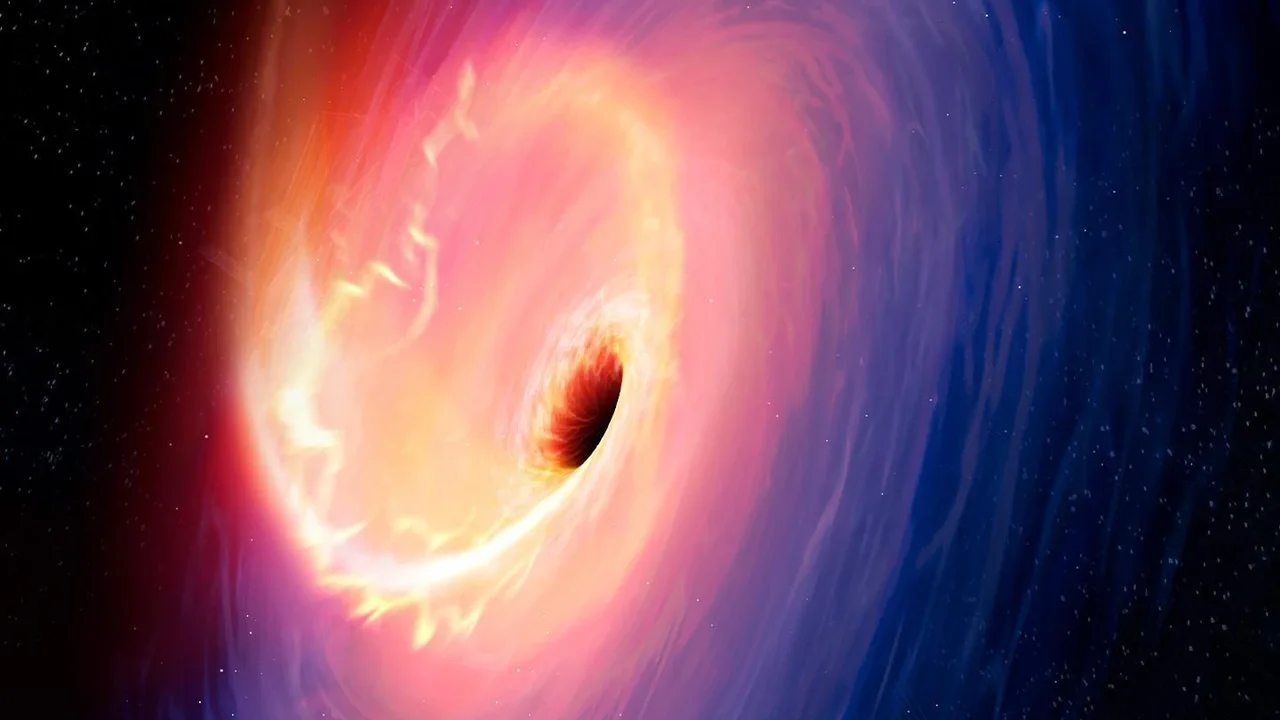
Black holes are famous for merging, but could one ever do the opposite and split in two? New theoretical research suggests this might not be entirely impossible, though it would require conditions so extreme they push the very limits of physics.
An Unbreakable Cosmic Law?
For decades,
the idea of a black hole splitting has been dismissed as a physical impossibility. This isn't just a hunch; it's rooted in one of the most fundamental principles of black hole physics: Hawking's area theorem. Proposed by Stephen Hawking in 1971, the theorem states that the total surface area of a black hole's event horizon—the point of no return—can never decrease. Since splitting one large black hole into two smaller ones would almost certainly result in a smaller total surface area, the process was considered forbidden by the laws of thermodynamics. This is because a black hole's area is directly related to its entropy, a measure of disorder. Just as a broken egg won't spontaneously reassemble itself, a black hole was not expected to divide into smaller parts, as this would represent a decrease in entropy that nature strongly disfavours.
The High Speed Loophole
A recent study published in the journal Physical Review D investigates a potential loophole in this longstanding rule. A team of physicists explored what might happen under one specific, exceptionally extreme condition if a black hole were spinning at or near its maximum possible speed. Their calculations suggest that this extreme rotation could change the thermodynamic equation. For a black hole spinning that fast, splitting could become thermodynamically favorable, meaning it would not violate the law of increasing entropy. This opens a narrow theoretical window for a single black hole to divide, challenging what scientists thought they knew.
< The 'Pair of Pants ' Problem < /h2 >
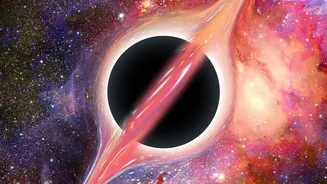
Even with this loophole , another major hurdle remains . For a split to be successful , the two new , smaller black holes would need to fly apart fast enough to avoid their own immense gravity pulling them back together into an immediate merger . According to the researchers , this escape is only possible if the original black hole was rotating at its absolute maximum physical limit . The team has dubbed the theoretical shape of this split a 'pair -of -pants topology ' , where the event horizon of the original black hole would stretch and divide into two 'legs ' , each containing one of the new black holes .
< /div >Beyond Einstein’s Gravity < /h2 >
It is important to stress that this is all still purely theoretical . The researchers note that the actual probability of a black hole splitting cannot yet be calculated because it depends on aspects of gravity that go beyond Einstein’s established theory . The study pushes into the realm of quantum gravity , the yet -to -be -discovered theory that will unite general relativity with THE physics OF THE very small . The authors suggest that small , primordial black holes , which are hypothetical objects formed in THE early universe , might be more likely candidates for splitting than THE massive astrophysical black holes we observe today . THE conditions required are so precise THAT THE ‘window’ OF opportunity FOR A split remains incredibly small .
< /div >