






The Plume's Journey to the Stratosphere
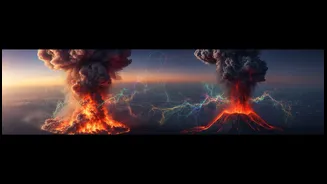
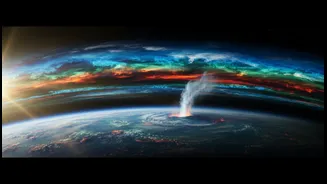
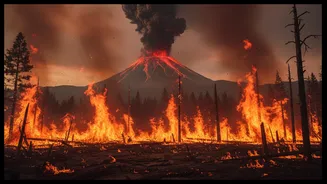
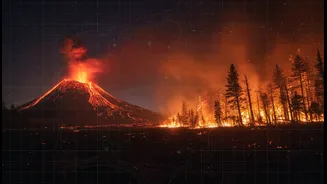
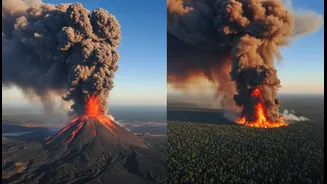
Not all smoke and ash reaches the stratosphere, the atmospheric layer sitting roughly 10 to 50 kilometres above Earth. It takes an event of immense energy. For wildfires, this happens through fire-triggered thunderstorms, known as pyrocumulonimbus or pyroCbs.
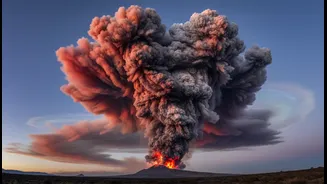
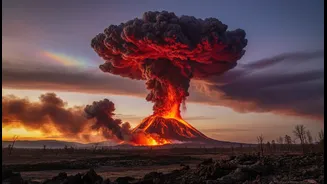
The intense heat from a megafire can generate a powerful updraft, creating a thundercloud that acts like a chimney, pumping smoke directly into the stable, dry stratosphere. Similarly, major volcanic eruptions have the explosive force to breach the lower atmosphere and inject gases and ash high above. The 2022 eruption of the underwater Hunga Tonga-Hunga Ha'apai volcano was so powerful it blasted an unprecedented amount of water vapour into the stratosphere. Once there, these plumes can drift for months or even years, circling the globe.
A Chemical Factory in the Sky
Once in the stratosphere, these particles and gases kick-start a series of chemical reactions. For volcanoes, the primary actor is sulfur dioxide. It converts into sulfuric acid aerosols that spread out to form a reflective haze. This haze can, paradoxically, aid the recovery of the ozone layer in some circumstances. Wildfire smoke, however, presents a newer and more troubling chemistry. Research following Australia's devastating 'Black Summer' fires in 2019-2020 found that smoke particles can trigger reactions that destroy ozone. Scientists discovered that compounds in aged smoke make it easier for chlorine, a known ozone-depleting substance, to become activated. Studies showed that the Australian fires contributed to a temporary 3-5% depletion of the ozone layer over mid-latitudes and widened the Antarctic ozone hole.
Turning the Planet's Thermostat
The climatic effects of these events are complex and often contradictory. Historically, large volcanic eruptions like Mount Pinatubo in 1991 have had a net cooling effect. The sulfate aerosols they produce reflect sunlight back into space, temporarily lowering global surface temperatures. Wildfire smoke is different. Its dark, carbon-rich particles can absorb sunlight, which warms the stratosphere. The underwater Hunga Tonga eruption added another layer of complexity. It injected relatively little of the cooling sulfur dioxide but shot a massive quantity of water vapour—a potent greenhouse gas—into the stratosphere, leading scientists to initially believe it would cause a warming effect. However, subsequent analysis suggests the overall impact was a slight cooling, at least in the Southern Hemisphere, demonstrating how many competing factors are at play.
The Fog of Forecasting
These massive, unpredictable events create major headaches for climate models and weather forecasts. Climate projections typically use a historical average for volcanic activity, but a single major eruption can throw those assumptions off for years, even if it doesn't alter the long-term warming trend. Similarly, weather forecast models struggle with smoke. Smoke plumes alter the amount of sunlight reaching the ground, which can lead to cooler-than-expected surface temperatures, throwing off predictions. The particles can also affect cloud formation and rainfall patterns. Models that predict the movement of smoke, like the HRRR-Smoke model in the US, are constantly being improved but face challenges. For example, a model's forecast can be delayed if satellites don't detect a fire immediately when it starts. As extreme fires become more common, scientists are working to better integrate these chaotic events into our forecasting systems to improve confidence in both short-term weather and long-term climate outlooks.