

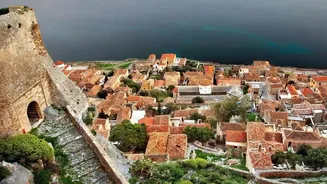
The Menalon Trail, Peloponnese
In the heart of the Peloponnese peninsula lies Arcadia, a region steeped in mythology and said to be home to Pan, the god of the wild. The 75-kilometre Menalon Trail guides hikers through this legendary landscape, connecting stone villages, deep gorges,
and dense fir forests. It was the first trail in Greece to be certified by the European Ramblers’ Association, a testament to its quality and maintenance by local volunteers. The route follows ancient mule tracks that once served as the primary link between communities. Trekkers will pass monasteries clinging to cliff faces, like the historic Prodromos Monastery in the Lousios Gorge, and the Open-Air Water Power Museum in Dimitsana, which showcases the industrial heritage that fueled the Greek Revolution. It is an immersive journey into a rugged, authentic part of the country that many visitors miss.
The Corfu Trail, Ionian Islands
Stretching around 220 kilometres from the island's southern tip to its northernmost point, the Corfu Trail offers a completely different perspective on this popular Ionian island. Created in 2001 by stitching together old shepherds' routes and forgotten paths, the trail was designed to showcase the island's rural heart, away from tourist hubs. The path winds through ancient olive groves, across sandy dunes next to Lake Korission, and up to Mount Pantokrator, the island's highest peak. Along the way, you’ll discover heritage sites like the 13th-century Panagia Theotokos monastery in Paleokastritsa and the abandoned Venetian-era village of Old Perithia. The trail gives walkers the freedom of a long-distance hike combined with the classic pleasures of Greek island life, like ending a day's walk at a hidden beach or a village taverna.
Crete's E4 European Path
Crete, Greece's largest island, is crossed by a section of the E4 European long-distance path, which stretches for over 500 kilometres from west to east. This is a trail of immense diversity, taking hikers from coastal villages and stunning beaches to the rugged White Mountains. The path is rich with history, passing through Minoan-era sites, ancient ruins, and Byzantine churches. Highlights include the Samaria Gorge, one of the longest in Europe, which served as a hideout for Cretan rebels during the Ottoman occupation. Other sections lead through the Amari Valley, past the ancient aqueduct of Lyktos, and up to the Ideon Cave in the Psiloritis Mountains, mythical birthplace of Zeus. Walking the E4 in Crete is an epic undertaking that rewards with a deep connection to the island's wild landscapes and millennia of history.
The Ursa Trail, Pindus Mountains
Named for the brown bears that inhabit the region, the Ursa Trail is a 40-kilometre certified route centered around the traditional town of Metsovo in the Pindus Mountains of northwestern Greece. 'Ursa' is the Vlach word for bear, and the trail is designed to lead hikers through the animal's habitat, promoting conservation and environmental awareness. It follows historic paths through dense forests of black pine and beech, passing stone fountains and art installations along the way. The trail offers a chance to experience the alpine beauty of mainland Greece, a landscape shaped by Vlach shepherds and merchants over centuries. The route connects to Metsovo, a picturesque town with stone houses and cobbled streets, offering a glimpse into the enduring culture of Greece's mountain communities.
Andros Routes, Cyclades
While most visitors come to the Cyclades for the beaches, the island of Andros offers a remarkable network of hiking trails. The Andros Routes project has restored and signposted over 160 kilometres of paths, including a continuous 100-kilometre route that earned the 'Leading Quality Trails' certification, a first for a European island. These paths, often stone-paved 'kalderimi', were the island's main transport network for centuries, connecting villages, monasteries, and agricultural lands. The trails traverse a surprisingly green and varied landscape, passing through the lush Dipotamata Valley with its old watermills, the Venetian-era Faneromeni Castle, and past countless dry-stone walls that terrace the hillsides. This volunteer-led initiative has revived the island's historical walkways, allowing visitors to explore its rich natural and man-made heritage on foot.