



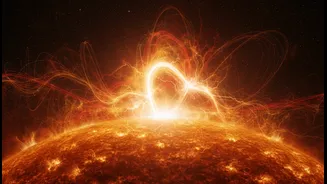
Seeing the Sun in a New Light
For centuries, our view of the Sun was limited to what we could see from Earth, often only during rare events like eclipses. The invention of the telescope allowed us to spot surface features like sunspots, but the deeper mechanisms driving solar activity
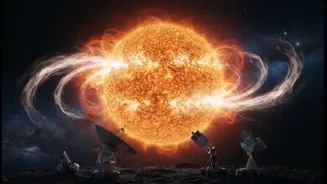
remained a mystery. While space-based probes like NASA's Parker Solar Probe and the European Space Agency's Solar Orbiter have revolutionised our understanding by flying closer to the Sun than ever before, a new wave of analytical techniques and ground-based observatories is adding another layer of insight, helping to connect the dots between the Sun's deep interior and its outer atmosphere.
The Hidden Conveyor Belt
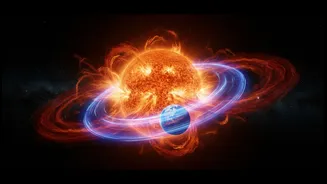
One of the most significant recent discoveries involves a slow, steady flow of hot gas, or plasma, that moves from the Sun's equator toward its poles. Known as the meridional flow, this process acts like a giant conveyor belt, transporting the Sun's magnetic fields and playing a key role in its 11-year solar cycle. Until recently, this flow had only been observed in the Sun's lower atmosphere. However, by using a novel image-correlation technique to analyse 27 years of radio observations from Japan's Nobeyama Radioheliograph, researchers have found the first clear evidence that this plasma movement continues much higher into the Sun's upper chromosphere, about 3,000 kilometres above the surface. This discovery, made by a team including scientists from India's Aryabhatta Research Institute of Observational Sciences (ARIES) and NASA, reveals a hidden link between the Sun's surface and its upper layers, offering fresh insights into how magnetic fields and plasma interact.
Listening to the Sun's Biorhythm
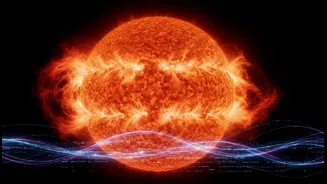
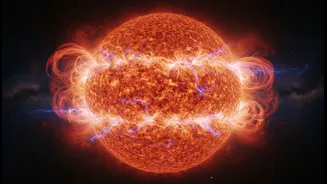
Other new monitoring techniques don't rely on sight at all, but on sound. Helioseismology studies the sound waves, or p-modes, that oscillate inside the Sun. By analysing decades of this data, astronomers have uncovered a mysterious pattern. They found that in recent solar cycles, the Sun's magnetic activity seems to be increasingly confined to a shallow layer just below the surface. This internal 'biorhythm' doesn't always match the activity we see on the surface, such as the number of sunspots. For example, the current Solar Cycle 25 has shown stronger internal activity than its surface features would suggest. This discrepancy helps explain why some solar activity predictions have been difficult and suggests that processes deep within the Sun are changing in ways we are only just beginning to understand.
Why This Matters for Earth
Uncovering the Sun’s hidden activity is not just an academic exercise; it has profound implications for our technology-dependent world. These newly understood processes drive space weather, including solar flares and coronal mass ejections, which can hurl clouds of charged particles toward Earth. A recent NASA-led study suggests that the impact of extreme solar storms may have been underestimated, challenging the long-held belief that there is a physical limit to how intensely Earth’s magnetosphere responds. More powerful storms could generate stronger geomagnetic disturbances than previously thought, posing a greater risk to satellites, GPS navigation, communication systems, and even our power grids. By better understanding the Sun's magnetic engine, scientists hope to improve their ability to forecast these potentially catastrophic events.
The Next Generation of Solar Sentinels
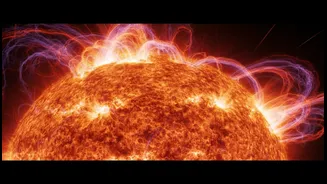
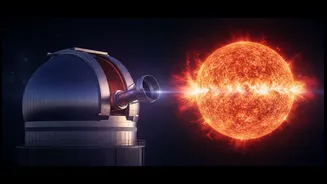
The quest to understand our star is powered by an incredible array of technology. The Daniel K. Inouye Solar Telescope in Hawai'i, the largest of its kind in the world, is providing unprecedentedly sharp images of the Sun's surface and corona. Its advanced instruments are capable of making ongoing measurements of the magnetic fields in the Sun's atmosphere, a region previously only observable in detail during an eclipse. At the same time, innovations in materials science are leading to the development of new optical components, like tiny metasurfaces that can analyse the Sun's magnetic fields more efficiently and at a lower cost for future space missions. These tools, combined with AI-powered analysis of satellite data, are creating a more complete and dynamic picture of the Sun than ever before.