
A Glimpse into a Ghostly Solar System
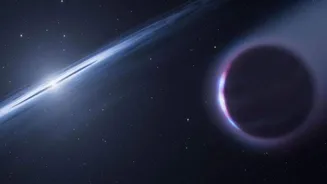
Scientists have announced the potential detection of a planet orbiting a white dwarf star named HS 0209+0832, located about 270 light-years from Earth. This isn't just any planet; it's a candidate for a 'second-generation' world. The discovery hinges
on a surprising chemical signature found in the white dwarf's atmosphere. By re-analysing 25-year-old data from the Hubble Space Telescope, a team led by the University of Warwick detected unusually high levels of heavy elements, including zinc, copper, and most notably, niobium. The amount of niobium, an element forged in the final, violent phases of a star's life, was over 1,000 times higher than that found in our own Sun. This strange composition suggests the white dwarf is actively pulling in material from a nearby object made from the star's own remains.
What is a White Dwarf?
To understand the significance of this finding, we need to know what a white dwarf is. It’s the final evolutionary stage for stars like our Sun. After a star exhausts its hydrogen fuel, it swells into a massive, luminous red giant. This expansion is catastrophic for any inner planets; a future red-giant Sun, for instance, will engulf Mercury, Venus, and possibly Earth. After this destructive phase, the star sheds its outer layers, leaving behind a hot, dense core about the size of Earth—the white dwarf. This stellar remnant no longer generates new heat through fusion and will spend billions of years slowly cooling down. Any planets that survived the red giant phase would either be pushed into much wider orbits or would have been destroyed entirely.
A Phoenix Planet Rises from the Ashes
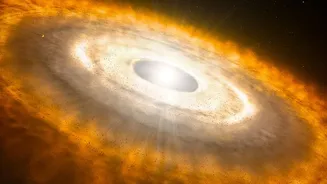
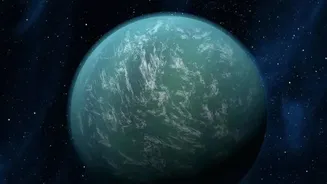
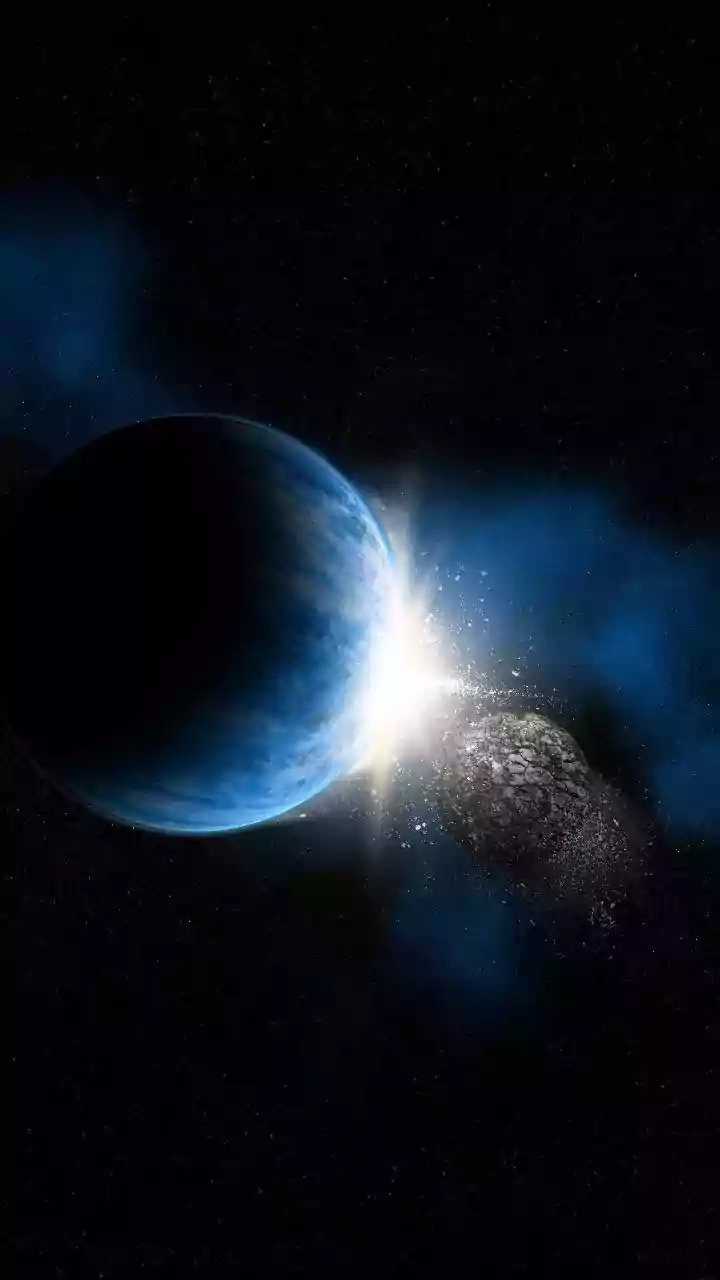
This is why the planet around HS 0209+0832 is so remarkable. Given its proposed tight orbit of just 4.4 days, it could not have been a 'first-generation' planet that survived the star's red giant phase. Instead, astronomers theorize it is a 'second-generation' planet, formed from the very material the star expelled as it died. The idea is that after the star became a white dwarf, the cast-off gas and dust formed a new 'protoplanetary disk' around the stellar remnant. From this debris disk, a new world—a Jupiter-sized gas giant—was born. The high concentration of elements like niobium in the white dwarf’s atmosphere is the smoking gun, as these elements would have been created inside the star and then incorporated into this newborn planet.
Evidence, Caution, and What Comes Next
The evidence is compelling but not yet conclusive, which is why the headline stresses caution. The primary clue is the strange chemical pollution in the white dwarf's atmosphere. Adding to this, data from NASA's TESS satellite detected a faint, regular dip in brightness from the system every 4.4 days. This signal is consistent with a large planet orbiting the star and being tidally locked, meaning the same side always faces the star. However, the existence of the planet itself has not been directly confirmed through imaging. Follow-up observations are crucial to verify that the TESS signal is indeed a planet and to study its characteristics more closely. Astronomers will be looking for more second-generation candidates by searching for similar chemical signatures in other white dwarfs.
Why This Cosmic Rebirth Matters
If confirmed, this discovery would be a landmark moment in astronomy. While second-generation planets have been theorized to exist around pulsars (the remnants of much more massive stars), finding one around a common white dwarf is 'completely unexpected', according to researchers. It suggests that planetary formation is not a one-time event that only happens when a star is born. Instead, it can be a cyclical process, with new worlds emerging from the death of old ones. This opens up a fascinating new chapter in the story of planetary evolution. It even offers a distant, speculative glimpse into the far future of our own solar system, suggesting that billions of years after our Sun dies, new planets could potentially form from its ashes. This finding redefines the end of a star's life not just as an ending, but as a potential beginning for new worlds.