





The Challenge of Living on the Moon
For astronauts to live and work on the Moon for extended periods, they need a constant supply of essentials like water, food, and, most critically, oxygen. The Moon has no atmosphere of its own, meaning every last molecule of breathable air for a lunar
base would traditionally need to be launched from Earth. This is an incredibly expensive and logistically challenging proposition. A single rocket launch has finite cargo space, and the weight of oxygen tanks would severely limit the amount of scientific equipment, habitats, and other vital supplies that could be sent. To make long-term lunar habitation under the Artemis program sustainable, NASA needs to figure out how to live off the land—a concept known as in-situ resource utilization (ISRU). This means using the Moon's own resources to produce what astronauts need, and the most abundant resource on the lunar surface is dust, or regolith.
From Dust to Breathable Air
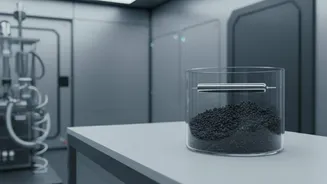
The lunar soil is surprisingly rich in oxygen, making up about 45% of its total weight. The catch is that this oxygen is chemically bonded with metals and silicon to form oxides, locking it away in solid rock and dust. The breakthrough comes from a NASA project called the Carbothermal Reduction Demonstration, or CaRD. In tests at Johnson Space Center, scientists placed simulated lunar soil into a specialized reactor chamber designed to mimic the vacuum of space. Inside the reactor, a high-powered laser heats the regolith to scorching temperatures, around 1700°C, causing it to melt. This intense heat, combined with a carbon source, triggers a chemical reaction that breaks the oxygen bonds, releasing it in the form of carbon monoxide gas. This gas is then collected, and a separate system can easily split it to yield pure, breathable oxygen.
A Reactor That Delivers More Than Oxygen
The beauty of the carbothermal reduction process is that breathable air isn't its only valuable output. After the oxygen is stripped away from the lunar soil, what's left behind are usable metals. The process effectively refines the regolith, leaving behind a mixture of iron, aluminum, and other metallic alloys. These materials could prove invaluable for future lunar settlers. Instead of launching heavy construction materials from Earth, astronauts could potentially use these extracted metals as raw material for 3D printing. This would allow them to manufacture tools, spare parts, and even structural components for buildings directly on the Moon. This dual-purpose capability makes the technology even more of a game-changer, turning a single process into a source for both life support and construction, dramatically reducing reliance on Earth-based supply chains.
Fueling the Artemis Generation
This ability to generate oxygen on-site is a cornerstone of NASA's long-term Artemis program, which aims to establish a permanent Moon base near the lunar south pole. Beyond breathing, a large-scale supply of lunar oxygen would serve another critical function: rocket propellant. Liquid oxygen is a key component of rocket fuel, and producing it on the Moon means future missions could refuel on the lunar surface. This would make the Moon a true interplanetary stepping stone. Spacecraft departing from the Moon for destinations like Mars would not need to fight Earth's strong gravity with a full tank of fuel, making deep-space missions more feasible and affordable. The success of the CaRD experiment paves the way for a future where a lunar base is not just a temporary outpost, but a self-sustaining hub of exploration and science.
What Are the Next Steps?
While the CaRD project successfully demonstrated the process in a simulated lunar environment on Earth, the next phase is to prepare it for the real thing. Engineers are working on scaling up the technology to produce larger quantities of oxygen—enough to support a team of astronauts. The plan involves building a flight-ready version of the reactor system that can be sent to the Moon on a future robotic mission as part of the Commercial Lunar Payload Services (CLPS) initiative. Once on the lunar surface, a rover could be used to scoop regolith and feed it into the reactor, testing the entire end-to-end process in the harsh lunar environment. The goal is to have this technology proven and operational to support the crewed missions that will build and inhabit the Artemis Base Camp in the 2030s.