





A Landmark Investment in 'Feel'
Eka Robotics, a startup with roots at MIT, has successfully closed a $150 million Series A funding round, catapulting its valuation to an impressive $1.45 billion. The round was co-led by major venture capital firms Andreessen Horowitz (a16z) and F-Prime,
with participation from Samsung Next and others. This isn't just a significant vote of confidence in one company; it signals a major investor bet on a new frontier in automation: robots that can perform dexterous physical manipulation. Eka’s mission is to move beyond robots that are merely programmed for repetitive action and create systems that can adapt to the physical world with a near-human sense of touch.
What Makes Eka's Robots Different?
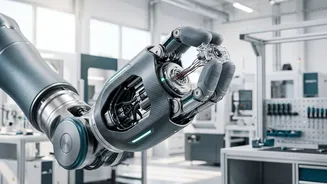
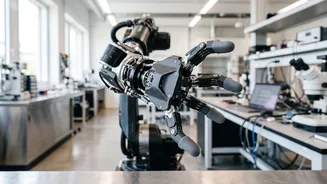
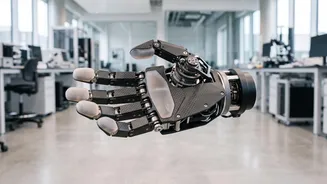
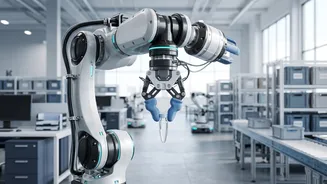
The core innovation at Eka is its 'Vision-Force-Action' (VFA) model. Most current robots rely heavily on vision, which is great for identifying an object's location but often fails when it comes to the delicate act of gripping it. Eka's co-founder, MIT professor Pulkit Agrawal, explains that the most critical part of grabbing something comes from understanding force and touch. Eka’s robots are equipped with highly sensitive grippers that provide rich data about force, allowing the AI to 'feel' an object and adjust its grip accordingly. This is the difference between a robot crushing a raspberry and picking it up perfectly. By training its AI in physics-based simulations, Eka can generate thousands of hours of practice in minutes, teaching the robots to master tasks far faster than by mimicking human demonstrations.
Beyond Human Speed and Accuracy
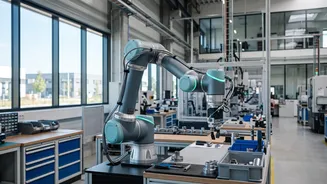
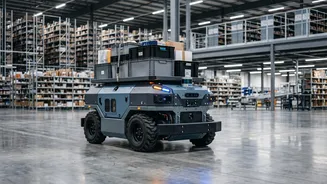
The results are already showing superhuman potential. Eka reports its robots can perform pick-and-place operations at a rate of 1,500 per hour, more than double the average human's speed of about 600 per hour, with a success rate of over 95%. This efficiency could transform industries like logistics, warehousing, and manufacturing, where speed and precision are paramount. The company is initially focusing on two key areas: 'pick-and-place' tasks and complex wire handling. The ability to handle delicate wiring or assemble server racks could unlock new levels of automation in electronics and data centre construction. While still in early pilots, the technology has impressed veteran roboticists, with some comparing it to the breakthrough moment when robots first learned to walk reliably.
India's Growing Robotics Ecosystem
While Eka Robotics is based in the US, its success is part of a broader global trend in which India is a rapidly emerging player. The Indian robotics market is projected to grow significantly, reaching an estimated $7.38 billion by 2034. Government initiatives promoting domestic manufacturing are fueling the adoption of automation across sectors. In 2025, India installed nearly 10,500 industrial robots, a 15% increase from the previous year, maintaining its position as the sixth-largest market in the world. Though the country's total operational stock of robots is still far behind leaders like China and Japan, its annual growth rate is among the fastest globally, indicating enormous potential. Breakthroughs like Eka's could inspire and accelerate further innovation within India's own burgeoning tech and manufacturing hubs.
The Future of Physical Work
The development of robots that can perform dexterous physical tasks raises important questions about the future of work. Eka's mission is to 'fundamentally reimagine how physical work gets done'. The goal is not necessarily to replace human workers but to create systems that can work safely alongside them, taking over tasks that are dangerous, repetitive, or require superhuman precision. However, the technology has a long way to go to prove its reliability in demanding industrial environments. The grippers, for instance, need to increase their durability to meet industrial standards. Still, this funding round marks a pivotal moment. It is a significant step toward a future where robots are not just tools of brute force but sophisticated partners capable of handling the physical world with intelligence and finesse.