







What Makes This Sight Special?
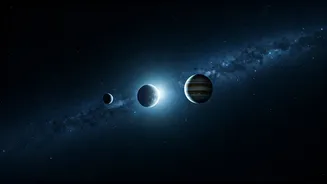
While seeing a planet or two is common, having three bright planets clustered in the same patch of sky is a less frequent treat. This isn't an 'alignment' in the sense that they are in a perfect straight line in space—they are millions of kilometres apart.
From our perspective on Earth, however, their orbits cause them to appear close together, creating a beautiful and dynamic celestial portrait. Venus and Jupiter are two of the brightest objects in our night sky, making them easy anchors. The real prize is spotting the elusive Mercury, which is often lost in the Sun’s glare. This brief window when all three are visible together is what makes the event worth your time.
The Perfect Time to Watch
Timing is everything, especially when Mercury is involved. The best window for viewing is a narrow one: start looking about 30 minutes after your local sunset and continue for the next 30 to 45 minutes. This is during twilight, when the sky is a deep blue but not yet completely black. It needs to be dark enough for the planets to pop, but not so late that they have already sunk below the horizon. Venus will likely be the first to appear, followed by the bright dot of Jupiter. Mercury will be the last to emerge from the Sun's fading glow and the first to disappear, so be patient and attentive during this specific time slot.
Where to Point Your Gaze
You don’t need a compass, just a general sense of direction. Face the same direction the Sun just set: the west. The planets will be gathered in a relatively low patch of the western sky. Since they follow the Sun's path, they won't be high overhead. Look for an unobstructed view of the western horizon. If you live in a city, this means finding a spot without tall buildings, trees, or billboards blocking your line of sight. A balcony, a rooftop, or a nearby park with a clear western view is your best bet. As the evening progresses, you'll see them slowly descend towards the horizon.
How to Identify Each Planet
Distinguishing the three planets is easier than you might think. Here’s the order of operations: 1. **Venus:** You can't miss it. It will be the most dazzlingly bright object in that part of the sky, far outshining any star. It looks like a brilliant, steady beacon of white light. Because it’s so bright, it will be the first one you spot. 2. **Jupiter:** Look for the second-brightest point of light in the vicinity. While not as blindingly bright as Venus, Jupiter is still a commanding presence. Like Venus, it shines with a steady, unwavering light, unlike stars which tend to twinkle. 3. **Mercury:** This is the challenge. Mercury will be the faintest of the three and will be positioned closest to the horizon. Look for a small, star-like dot below or near the other two planets. Its light is steady, but its faintness and proximity to the horizon’s haze can make it tricky to find. Be patient and let your eyes adjust.
Tips for the Best Viewing Experience
To improve your chances, especially in a city, follow these simple tips. First, find the darkest spot you can. Even moving to a corner of a park away from a direct streetlight can make a huge difference. Second, give your eyes time to adapt to the dark—at least 10-15 minutes without looking at your phone screen. This will make fainter objects like Mercury much easier to see. While you don’t need a telescope, a simple pair of binoculars can dramatically enhance the view. They will make Mercury pop and might even reveal Jupiter's four largest moons (the Galilean moons) as tiny pinpricks of light lined up next to the planet.
Use Your Smartphone as a Guide
If you’re having trouble, let technology help. There are several excellent and free stargazing apps that use your phone's GPS and compass to show you exactly what’s in the sky. Simply point your phone at the western horizon, and the app will overlay the names of the planets and constellations on your screen. Popular choices include SkyView Lite, Star Walk 2, and Stellarium Mobile. These apps are fantastic for beginners, as they take the guesswork out of identifying celestial objects and can help you confirm that the bright dot you're looking at is, in fact, Jupiter and not a passing airplane.