
The Solar System's Moon King
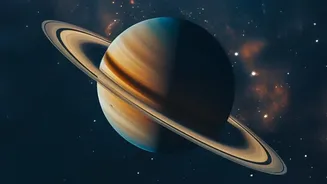
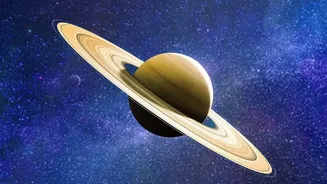
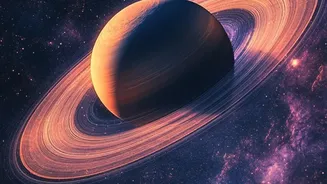
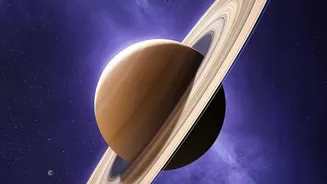
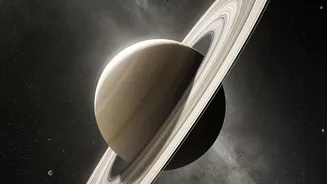
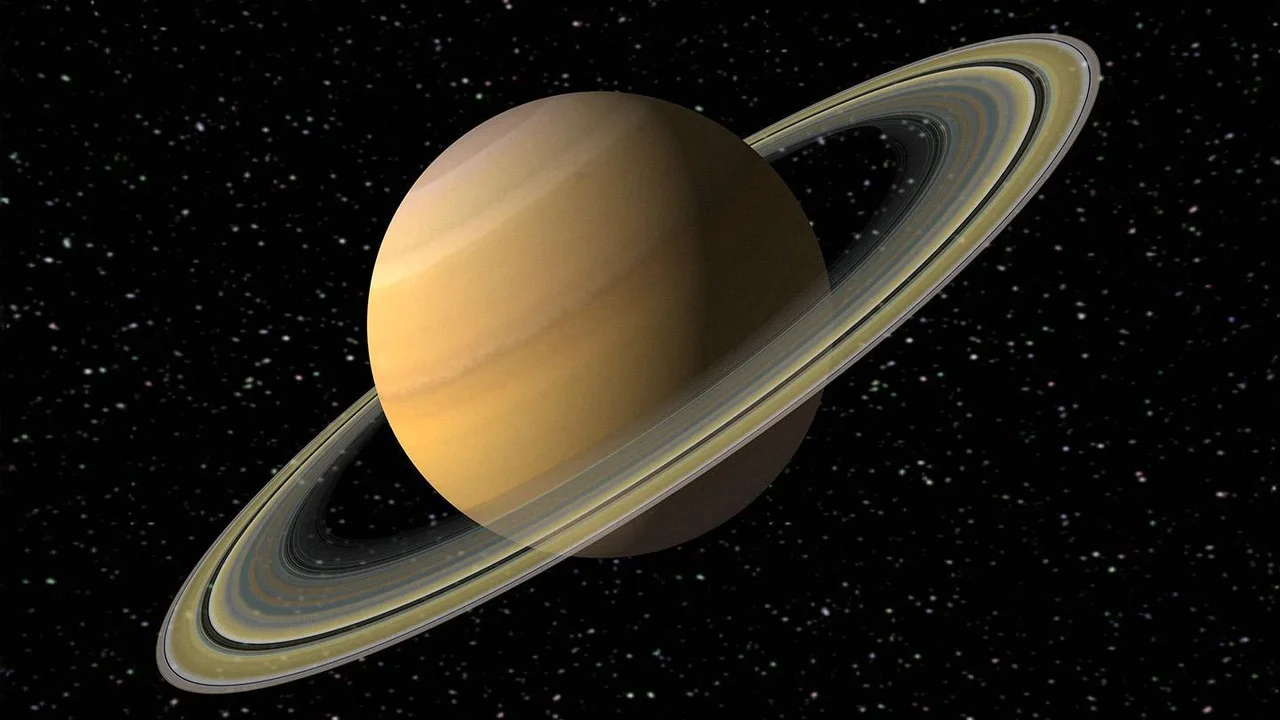
For a long time, Jupiter held the title for the most known moons. However, recent discoveries have firmly placed Saturn in the lead. A massive batch of 128 new moons was confirmed in March 2025, a discovery that nearly doubled the planet's total overnight.
This surge isn't just a numbers game; it represents a significant leap in our ability to peer into the distant corners of our own cosmic neighbourhood. These discoveries are changing our understanding of how planetary systems form and evolve, suggesting a turbulent past filled with collisions that created the small, irregular moons we are finding today.
Hunting for Faint, Tiny Worlds
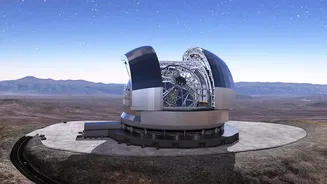
Discovering these new moons is a monumental task. Most are incredibly small—some just a few kilometres in diameter—and orbit far from Saturn, making them faint and difficult to spot. Researchers rely on powerful ground-based telescopes, like the Canada-France-Hawaii Telescope, to capture deep images of the sky around the planet. The key is a technique called 'shift and stack'. Astronomers take a series of images over several hours and then digitally shift and layer them to follow the predicted path of a potential moon. This process makes the faint light of a tiny, moving object add up, allowing it to become visible against the background stars.
What Makes a Moon a Moon?
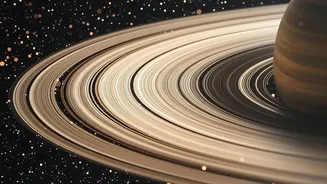
The definition of a moon is surprisingly simple. According to the International Astronomical Union (IAU), a moon is any natural celestial body that orbits a planet, dwarf planet, or even an asteroid. Unlike planets, there is currently no minimum size requirement. If a chunk of rock is naturally occurring and has a stable orbit around a larger, non-stellar body, it's considered a moon. This is why it's difficult to distinguish between the smallest moons and the largest particles in Saturn's rings. The crucial step for researchers is confirming a stable orbit, which can take months or even years of follow-up observations to track the object's path and ensure it's truly captured by Saturn's gravity.
Regular vs. Irregular Families
Not all of Saturn's moons are alike. Scientists group them into two main categories: regular and irregular. Regular moons, like the massive Titan and the ocean-bearing Enceladus, have nearly circular, prograde orbits (meaning they travel in the same direction as Saturn's rotation) and lie close to the planet's equatorial plane. They are believed to have formed from the same disk of gas and dust as Saturn itself. In contrast, the vast majority of the newly discovered moons are irregular. These have large, tilted, and often retrograde (backwards) orbits. Astronomers believe these are captured objects—passing asteroids or comets that were snared by Saturn's immense gravity long ago. Their orbits often cluster together, suggesting they are fragments of larger parent moons that were shattered by ancient collisions.
The Naming Convention
Once a new moon's orbit is confirmed, it is given a provisional designation, like S/2019 S 1. Eventually, it receives a permanent name overseen by the IAU. To manage the sheer number of discoveries, Saturn's moons are named based on their orbital groups. Following a tradition established by John Herschel in 1847, the inner moons are often named for Greek and Roman Titans. For the newer, irregular moons, the IAU has expanded the naming scheme to include giants and figures from Gallic, Norse, and Inuit mythologies, reflecting the diverse orbital families they belong to.