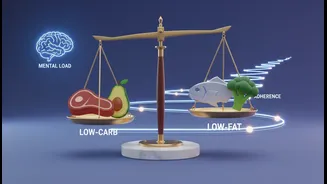









The Search for the 'Best' Diet
The wellness world is flooded with advice on how to lose weight, with new trends emerging constantly. For many, the central debate boils down to two dominant philosophies: meticulously counting every calorie versus restricting the times of day you eat.
Traditional calorie restriction has been a cornerstone of weight management for decades. In contrast, intermittent fasting (IF), which focuses on when you eat rather than what you eat, has gained immense popularity for its simpler, less granular approach. The endless question for dieters has been: which one actually works better? New research provides a nuanced answer, suggesting that while both roads can lead to the same destination, the journey is quite different.
Approach 1: The Discipline of Calorie Restriction
Daily calorie restriction (DCR) is the classic approach to weight loss. The principle is straightforward: consume fewer calories than your body burns. This method offers flexibility, as no foods are strictly off-limits, provided they fit within your daily calorie budget. For those who enjoy data and structure, using apps to track meals can feel empowering. However, the constant need for vigilance—measuring portions, reading labels, and logging every bite—can lead to decision fatigue and what some call 'food noise'. Research from Adelaide University highlighted that people on a calorie-restricted diet often feel they must constantly and consciously limit their intake to achieve results.
Approach 2: The Simplicity of Intermittent Fasting
Intermittent fasting comes in several forms, but most popular versions involve time-restricted eating (TRE), such as the 16:8 method (fasting for 16 hours and eating within an 8-hour window). The appeal lies in its simplicity; instead of counting calories, you're counting hours. For many, this eliminates the mental burden of food tracking. Proponents find that a smaller eating window naturally leads to a reduction in overall calorie intake, often between 350 to 500 calories per day, without the need for meticulous logging. The main challenge can be social—fitting restricted eating times around family meals or events—and resisting the urge to overcompensate during eating periods.
The Study's Surprising Findings
A recent head-to-head comparison from Adelaide University, published in July 2026, sheds light on the debate. Researchers followed groups on an intermittent fasting plan and a daily calorie restriction plan for six months. The headline result? Both groups lost a similar amount of weight—an average of about seven kilograms. This confirms findings from several other studies showing that, when the overall calorie deficit is similar, neither method proves significantly superior for shedding pounds. There were also no major differences in most cardiometabolic health markers like cholesterol or blood pressure between the groups. However, the study uncovered a crucial psychological difference.
A Different Mental Game
The key distinction between the two approaches wasn't on the scale, but in the mind. Participants in the intermittent fasting group reported achieving weight loss without feeling like they had to constantly monitor their food intake or fight the urge to overeat. In contrast, the calorie-counting group felt their success was tied to ongoing, conscious restraint. This suggests that intermittent fasting may be a more sustainable option for individuals who struggle with the mental fatigue of traditional dieting, sometimes called 'yo-yo dieters'. According to Professor Leonie Heilbronn, one of the study's authors, fasting may offer a path that is less dependent on consciously restricting every mouthful, which could make it easier to stick with long-term.
Which Approach Is Right for You?
Since both methods are effective for weight loss, the 'best' diet is truly the one that fits your personality and lifestyle. If you thrive on data, enjoy tracking your progress, and want the flexibility to eat at any time of day, traditional calorie counting could be a great fit. You have full control over your food choices as long as you stay within your target. On the other hand, if the idea of logging every meal feels draining and you prefer clear-cut rules that don't require constant calculation, intermittent fasting might be the answer. By focusing only on your eating window, you can free up mental energy previously spent on food decisions. Ultimately, the research suggests that adherence is the most critical factor, and choosing a method you can sustain is more important than the method itself.