



The Key: Propulsion, Not Support
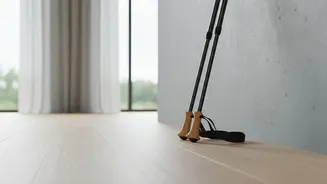
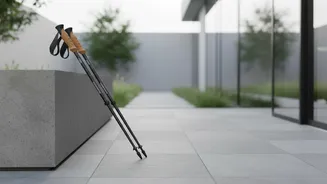
The secret to effective Nordic walking lies in understanding the poles' primary purpose. They aren't just for balance or support like trekking poles; they are tools for propulsion. The entire technique is designed to engage your upper body to push you forward
with each step. This transforms walking, a lower-body exercise, into a comprehensive workout that engages up to 90% of your body's muscles. By actively using the poles to propel yourself, you increase your heart rate and calorie burn significantly compared to regular walking, with some studies estimating an increase of 18% to 67%. The goal is to harness the power of your back, shoulders, and arms to share the workload with your legs.
Mastering the Arm Swing and Pole Plant
Proper form begins with your posture and arm movement. Walk tall with a slight forward lean from the ankles, keeping your shoulders relaxed and your gaze ahead. The arm swing is the engine of the movement. It should originate from the shoulder, not the elbow, with a relatively straight arm. As you step forward with your left foot, your right arm swings forward naturally, and vice-versa, maintaining the body's natural diagonal coordination. The pole should be planted at an angle, roughly in line with the heel of your opposite foot. A common mistake is planting the pole too far in front of you, which acts as a brake. Instead, think of the plant as the beginning of a powerful push that will propel you through your stride.
The Push-Off and Hand Release
After planting the pole, the 'push' phase begins. As your arm swings backward, you push firmly through the pole and its strap. This is where the real work happens. This push-off engages the major muscles of your upper body. To achieve a full range of motion, allow your hand to open at the end of the swing, guiding the pole backward past your hip. Modern Nordic walking straps are designed like a glove to allow you to do this without losing contact with the pole. This open-hand technique ensures a fluid motion and maximizes the engagement of your triceps, latissimus dorsi (lats), and shoulder muscles. A weak push is a frequent error; if you stop pushing through the poles, you should feel a noticeable drop in speed and an increase in the effort required by your legs.
Muscles Engaged and Full-Body Benefits
When performed correctly, Nordic walking is a true full-body workout. While your legs do the walking, the poles bring the entire upper body into play. The push-off specifically targets your triceps (the back of your arms), deltoids (shoulders), pectorals (chest), and the large latissimus dorsi muscles in your back. It also engages your core abdominal muscles for stability throughout the movement. This increased muscle activation is why Nordic walking is so effective at building upper-body strength, improving posture, and increasing cardiovascular fitness. Furthermore, by distributing the effort across your whole body, the poles actually reduce the stress on lower-body joints like knees and hips, making it an excellent low-impact exercise.
Common Upper-Body Mistakes to Avoid
Many beginners make a few common mistakes that limit the benefits of their walk. First is bending the elbows too much instead of swinging from the shoulder; this uses smaller arm muscles instead of the powerful back and chest muscles. Second is planting the poles vertically like walking sticks instead of at an angle for propulsion. Another error is maintaining a death grip on the pole throughout the swing, which prevents the full, fluid push-off and can cause tension. Finally, avoid moving the arm and leg on the same side together, which disrupts your natural rhythm; focus on the opposite-arm, opposite-leg coordination that defines walking.