


Meet Centaurus A
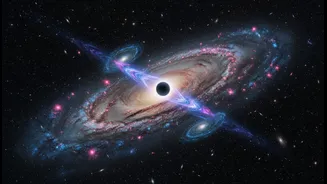
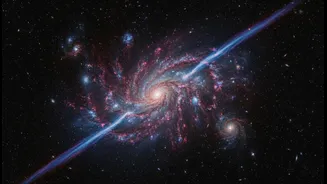
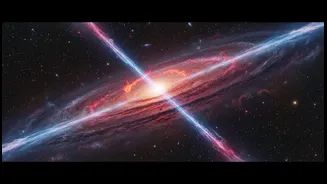
Located about 11 million light-years from Earth, Centaurus A is a cosmic neighbor. But unlike most nearby galaxies, it's incredibly active. At its heart lies a supermassive black hole that is actively consuming material, launching powerful jets, and releasing
immense energy. This makes it a perfect natural laboratory for scientists. What makes it even more interesting is its dramatic history. Roughly two billion years ago, Centaurus A collided with and merged with another galaxy, an event that left it with a distinctly unusual and warped structure. These features, combined with its proximity, make it an ideal target for understanding how galaxies grow and evolve over time.
Peering Through the Dust
Previous telescopes have struggled to get a clear view of Centaurus A's core. Its center is shrouded in thick lanes of cosmic dust, which block observations in visible light—the kind our eyes, and the Hubble Space Telescope, can see. While older infrared telescopes like the Spitzer Space Telescope could see the galaxy's larger structures, they lacked the power to resolve individual stars. This is where the James Webb Space Telescope (JWST) changes the game. Its powerful infrared instruments, specifically the Near-Infrared Camera (NIRCam) and Mid-Infrared Instrument (MIRI), can pierce through the obscuring dust. The result is an image of unprecedented clarity, transforming what was once a blurry region into a tapestry of millions of individual stars.
A Story Written in Starlight
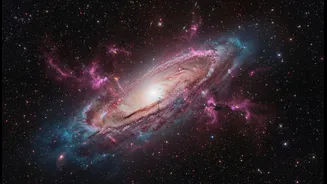
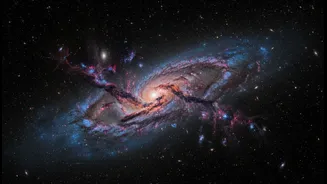
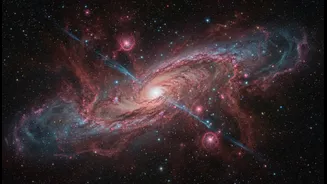
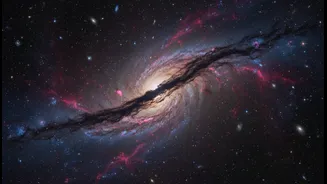
With this new level of detail, astronomers can now practice a kind of galactic archaeology. What appears as a grainy texture in Webb's image is actually a dense field of countless stars, each holding clues to the galaxy's past. By studying these stars, scientists can begin to piece together a timeline of Centaurus A's evolution. They can identify when the oldest stars first formed, when a burst of new star formation was triggered by the ancient galactic collision, and how stars continued to be born from the gas stirred up in the aftermath. The glowing reddish-purple areas in the image highlight stellar nurseries, where new stars are forming and old stars are shedding material back into the galaxy.
Unraveling Cosmic Mysteries
Beyond the stars, Webb’s view reveals the intricate and surprisingly complex structures of the galaxy's dust. These glowing, wispy shapes perplex and fascinate astronomers. One particularly unusual feature is a warped, parallelogram-like band across the galaxy's center. Another is a mysterious S-shaped structure that may be linked to the black hole's activity or the ancient merger. Using spectroscopy, which analyzes how light from the galaxy moves, scientists have already detected warm hydrogen gas rotating near the black hole and other ionized gas flowing rapidly outward. These observations provide a rare, close-up look at the complex interplay between a supermassive black hole and its host galaxy—how it can both trigger and suppress star formation.