

The Junkyard Above Our Heads
It’s an invisible crisis happening hundreds of kilometres above us. For decades, every rocket launch and satellite deployment has left something behind. Today, low Earth orbit is a sprawling junkyard of defunct satellites, spent rocket stages, and millions
of tiny fragments from past collisions and explosions. There are over 29,000 trackable objects larger than a coffee cup, with millions more too small to monitor but still dangerous. Travelling at speeds of nearly 30,000 km/h, even a tiny paint fleck can hit with the force of a hand grenade, capable of disabling a multi-billion dollar satellite or endangering the lives of astronauts. This growing cloud of debris threatens the satellite infrastructure we rely on for communication, weather forecasting, and navigation.
The Danger of a Cosmic Chain Reaction
The biggest fear among space agencies is a scenario known as the Kessler Syndrome. Proposed by NASA scientist Donald J. Kessler in 1978, it describes a tipping point where the density of debris becomes so high that collisions generate more debris, which in turn causes more collisions. This cascading chain reaction could eventually make certain orbits completely unusable for generations, effectively trapping us on Earth. Events like the 2009 collision of two intact satellites, which created thousands of new fragments, show that this is no longer just a theory. To prevent this, active debris removal is no longer a luxury, but a necessity.
The Harpoon: A Classic Tool for a Modern Problem
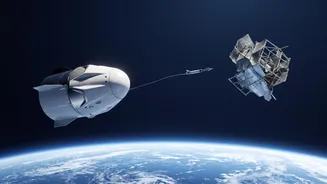
One of the most direct solutions being tested is surprisingly low-tech in concept: a harpoon. Inspired by ancient whaling techniques, space agencies like the European Space Agency (ESA) are developing systems where a 'chaser' spacecraft fires a tethered harpoon into a piece of large debris, like a defunct satellite. Once speared, the chaser can pull the target to control its tumble and then drag it down to burn up harmlessly in Earth's atmosphere. The concept has already been successfully demonstrated in orbit. The 2018 RemoveDEBRIS mission, led by the University of Surrey and co-funded by the European Commission, successfully fired a harpoon at a target panel at 20 meters per second, proving the technology's viability for capturing debris.
Casting a Wide, Magnetic Net
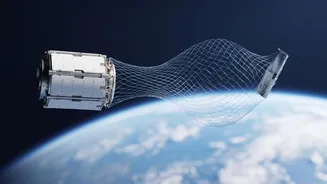
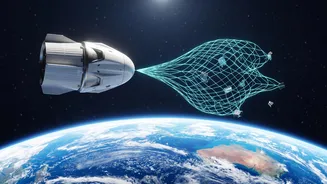
For capturing smaller fragments or objects that are tumbling too erratically to harpoon, researchers are turning to nets. The same RemoveDEBRIS mission that tested the harpoon also successfully demonstrated deploying a net to ensnare a target. But a new evolution of this idea incorporates magnetism. One concept involves an 'Electromagnetic-net Carrier' system that combines a physical net with electromagnetic properties. This allows it to capture both magnetic and non-magnetic debris. Other radical ideas involve using powerful, spinning magnets on a chaser satellite to create forces that gently nudge or control a piece of metallic, but non-magnetic, debris without ever touching it, moving it into a safer, decaying orbit. Japan's aerospace agency, JAXA, has also explored concepts using a large, electrodynamic tether to generate a magnetic field to attract and collect junk.
Beyond Nets and Harpoons: Lasers and Grippers
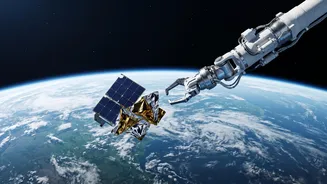
The innovation doesn't stop there. Robotic arms with complex grippers are a leading option, with missions like ESA's ClearSpace-1 planning to use a four-armed claw to grab and de-orbit a specific piece of rocket debris. Another futuristic concept involves using powerful ground-based or space-based lasers. These wouldn't destroy the debris, but rather 'nudge' it by vaporizing a tiny part of its surface through a process called laser ablation. This creates a small amount of thrust that can alter the object's orbit over time, pushing it onto a path where it will re-enter the atmosphere. While still largely theoretical for large-scale use, this method could be effective for dealing with smaller pieces of debris that nets and harpoons can't target.
The Long Road to a Clean Orbit
While these technologies are incredibly promising, the challenges are immense. The sheer scale of the problem is daunting, and active debris removal missions are complex and expensive, often costing hundreds of millions of dollars for a single target. Companies like Astroscale are pioneering commercial models, with missions designed to inspect and eventually de-orbit old rocket bodies, aiming to create a reusable and more cost-effective service. However, international law and liability remain thorny issues—who is responsible for removing a defunct satellite, and who pays if a removal attempt goes wrong? Without clear international agreements and a concerted global effort, even the most advanced laser harpoons will only be chipping away at a mountain of junk that continues to grow.