



From Blurry Dots to Weather Maps
For decades, most exoplanets—planets orbiting other stars—were little more than a wobble in a star's light or a tiny dip in its brightness. We knew they were there, and we could sometimes guess their size or mass, but understanding what they were like
was largely theoretical. Their atmospheres, the very thing that dictates weather, were almost complete mysteries. Early observations with telescopes like Hubble gave us tantalizing hints, but details were often obscured. It was like trying to understand Earth's climate by looking at it through a thick fog. But that frustrating era is rapidly coming to an end. We are moving from simply detecting planets to characterizing them in incredible detail.
A New Eye on the Cosmos
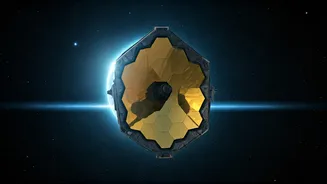
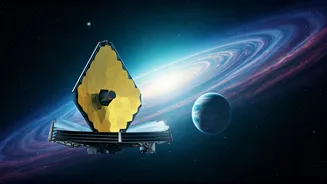
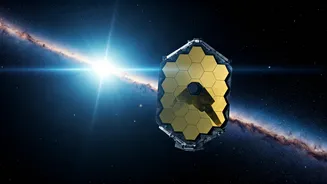
The primary game-changer is the James Webb Space Telescope (JWST). Launched in 2021, its massive mirror and advanced instruments are designed to see the universe in infrared light. This is crucial for studying exoplanets. When a planet passes in front of its star, JWST can analyze the starlight that filters through the planet's atmosphere. Different chemical elements and molecules absorb light at specific infrared wavelengths, leaving a unique fingerprint. By reading this fingerprint, a technique called transit spectroscopy, scientists can identify water vapor, methane, sulfur dioxide, and even the components of clouds. This capability has transformed the field, turning what was once educated guesswork into observational science.
Case Study: Cloudy Mornings, Clear Evenings
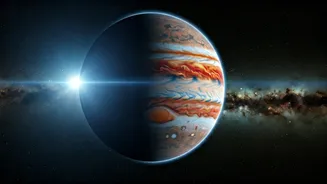
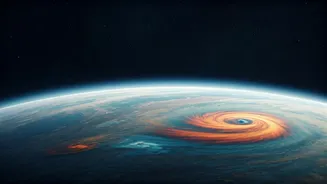
One of the most remarkable recent discoveries involves a 'hot Jupiter' named WASP-94A b. Using JWST, astronomers were able to observe the planet's atmosphere as it began and ended its transit across its star. What they found was a dynamic, planet-wide weather cycle. The planet’s morning side, where air flows from the cold, permanent nightside, was thick with clouds made of silicate minerals—essentially, sand. But the evening side was surprisingly clear. This finding, the first detection of a repeating cloud cycle on an exoplanet, showed that planets aren't uniform spheres. They have distinct, regional weather patterns, just like Earth. Researchers now believe this pattern of cloudy mornings and clear evenings may be common on other hot gas giants.
Beyond Clouds: Winds and Magnetic Fields
The new tools aren't just revealing clouds; they're uncovering the forces that drive alien weather. On a group of 'ultra-hot Jupiters', astronomers expected to find that hotter planets had faster winds. Instead, using ground-based observatories like the Very Large Telescope, they found the opposite. Something was slowing the winds down on the most blisteringly hot worlds. The culprit, they believe, is powerful magnetic fields. This was the first time the magnetic environment of an exoplanet could be compared to others, a critical factor in determining a planet’s ability to hold onto its atmosphere and, potentially, water. In other cases, like the 'super-puff' planet WASP-107b, JWST has witnessed an atmosphere being stripped away in real time, with a tail of escaping helium gas stretching nearly ten times the planet's radius.
The Forecast for the Future
Studying exoplanet weather is about more than just cosmic curiosity. The same techniques used to find silicate clouds on a gas giant can one day be used to find signs of life on a rocky, Earth-like world. An atmosphere's composition can point to biological processes (biosignatures) or geological activity that might make a planet habitable. Recent JWST observations have already detected the atmosphere of a planet orbiting a dead star, offering a glimpse into our own solar system's distant future. Every discovery about how atmospheres work, how clouds form, and how winds blow on these strange worlds brings us a step closer to answering one of humanity's biggest questions: are we alone? We are no longer just planet hunters; we are becoming explorers of alien skies.