
Seeing the Invisible with Infrared
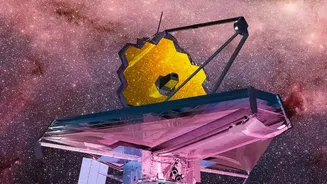
The secret to the James Webb Space Telescope’s revolutionary view is its ability to see the universe in infrared light. Many stellar nurseries, the vast clouds of gas and dust where stars form, are opaque to telescopes that see in visible light, like
the Hubble. This is because visible light's shorter wavelengths are easily scattered or absorbed by dust particles. Infrared light, however, has longer wavelengths that can slip past the cosmic dust, much like how firefighters use infrared cameras to see through smoke. This allows the JWST's powerful instruments, the Near-Infrared Camera (NIRCam) and the Mid-Infrared Instrument (MIRI), to pull back the cosmic curtain and capture the processes of star birth that were previously hidden from view.
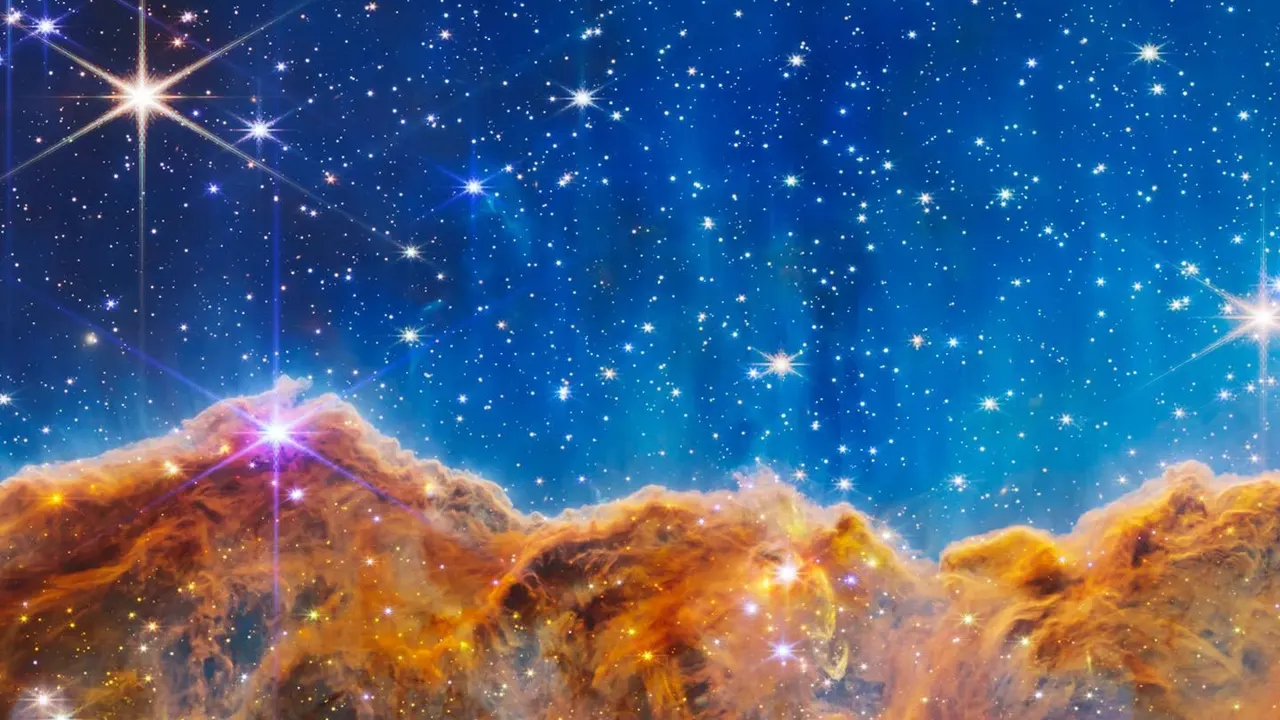
Inside the ‘Cosmic Cliffs’
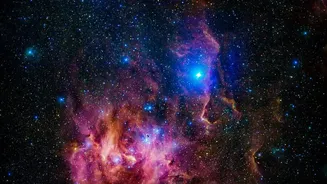
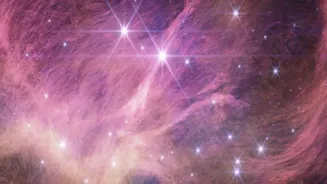
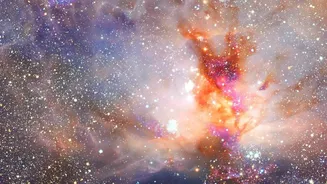
Perhaps the most iconic example of Webb's power is its image of the 'Cosmic Cliffs' in the Carina Nebula, a star-forming region roughly 7,600 light-years away. What was once a partially obscured area is now a breathtaking landscape of 'mountains' and 'valleys' of gas and dust. These structures are being sculpted by intense ultraviolet radiation and stellar winds from massive, young stars located just outside the frame. Webb’s view has unveiled hundreds of previously hidden stars within this cosmic cavern. Even more excitingly, it has revealed protostellar jets and outflows—material shooting out from nascent stars—that appear as golden streams. These are the clear, unambiguous signs of stars in the earliest, most rapid, and difficult-to-capture phases of their formation.
The Secret Life of a Baby Star
The JWST is providing an unprecedented look at the life of protostars—infant stars still gathering mass from their parent cloud. For the first time, astronomers can clearly see the earliest stages of formation, a period lasting only 50,000 to 100,000 years. In images of protostars like L1527, Webb has revealed a central star hidden within a dark, edge-on protoplanetary disk—a swirling band of gas and dust the size of our solar system that will one day form planets. Light escapes from above and below this disk, illuminating cavities in the surrounding gas and creating a spectacular hourglass shape. By analyzing these images, scientists have discovered dozens of previously unknown jets and outflows, providing crucial data on how a star takes in material while simultaneously blasting a portion of it back into space.
Challenging What We Know
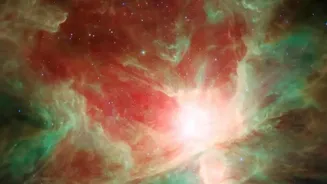
Beyond confirming theories, Webb's observations are also raising new questions and rewriting old models. For instance, in the Ophiuchus star-birthing region, astronomers detected unexpected, high-energy ultraviolet (UV) radiation around five infant stars. This was a surprise, as protostars are not supposed to be capable of producing such high-energy radiation themselves. This discovery forces scientists to reconsider the sources of energy and radiation in these stellar nurseries, suggesting that shocks from infalling material or from the powerful jets themselves could be the cause. This new puzzle is a perfect example of how the telescope is not just providing answers, but is pushing the boundaries of our astronomical knowledge and forcing a deeper understanding of the environments where stars like our own Sun were born.