



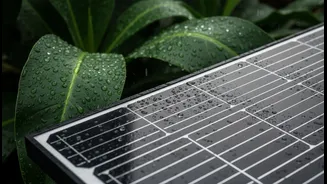
The Monsoon Challenge for Solar
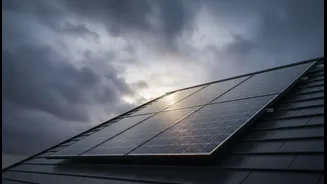
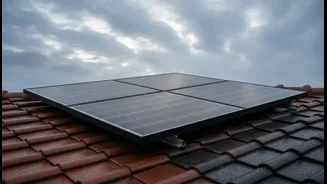
India's push for renewable energy has seen millions of homes and businesses adopt rooftop solar. It’s a powerful tool for energy independence and lower bills. However, the system has an Achilles' heel: the monsoon. From June to September, persistent cloud
cover can slash a solar panel's output significantly. While conventional panels do generate some power from diffused sunlight, their efficiency drops dramatically without direct sun. On heavily overcast days, production can fall by over 60%, turning an otherwise reliable power source into a frustratingly intermittent one. This seasonal dip is a major hurdle for a country aiming to achieve ambitious solar targets, as it makes grid-dependent backup power a necessity during a large part of the year.
Enter a New Kind of Solar Technology
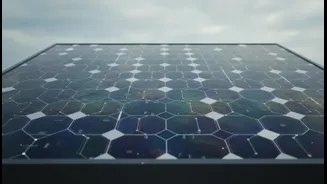
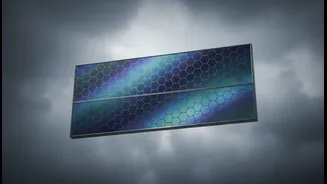
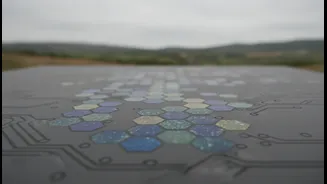
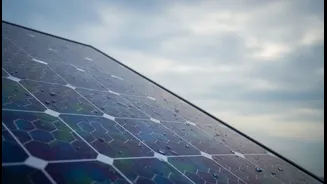
The solution lies in a new generation of solar cells that are far more effective in low-light conditions. The most promising of these are perovskite solar cells. Perovskites are a class of materials with a specific crystal structure that is incredibly good at absorbing light. Unlike traditional silicon panels, which are rigid and have a fixed efficiency, perovskite cells can be formulated into a thin, flexible, and lightweight film. This material can be 'tuned' to capture different wavelengths of light, including the ambient and indirect light that dominates on a cloudy day. This makes them uniquely suited to climates like India's, where consistent, bright sunlight isn't guaranteed year-round.
How They Work in Dim Light
Traditional solar panels need the strong, direct energy of bright sunlight to efficiently knock electrons loose and create a current. Diffused light on a cloudy day just doesn't provide the same punch. Perovskite cells, however, are fundamentally different. Their unique structure allows them to absorb a wider spectrum of light and operate efficiently even when photons are scarce, such as indoors or under heavy cloud cover. In fact, some recent studies have shown certain perovskite cells achieving a power conversion efficiency of over 38% in low, indoor light—far surpassing what silicon can do in similar conditions. The most exciting development is the 'tandem' cell, which stacks a thin layer of perovskite on top of a traditional silicon cell. The perovskite layer captures the high-energy light, while the silicon below captures the rest, boosting overall efficiency in all weather conditions.
The Game-Changer for India's Energy Goals
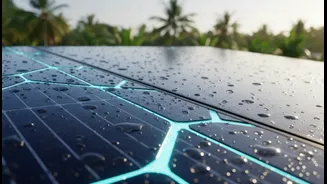
The implications for India are enormous. Imagine rooftop solar systems that continue to generate substantial power throughout the monsoon, reducing the reliance on diesel generators and expensive grid electricity during outages. This technology could make residential and commercial solar a truly year-round, reliable investment. It would not only help households achieve true energy independence but also bolster the national grid. For a country that has set an ambitious target of 500 gigawatts from renewable sources, having solar technology that performs reliably in its unique climatic conditions is critical. It would make rooftop solar a much more attractive proposition in high-rainfall states like Kerala and those in the Northeast, further democratizing energy generation.
Hurdles on the Horizon
While the promise is great, perovskite technology is still in its early stages of commercial rollout. The biggest challenges are durability and cost. Early-generation perovskite cells tend to degrade when exposed to moisture and heat over long periods—a significant concern in India. Researchers are actively working on new formulations and protective layers to extend their lifespan to match the 25-year standard of silicon panels. While the raw materials are inexpensive, scaling up manufacturing to bring down the final cost is another major hurdle. Furthermore, the rooftop solar sector in India already faces challenges with financing, inconsistent quality from installers, and bureaucratic delays, which would also need to be addressed for any new technology to be widely adopted.