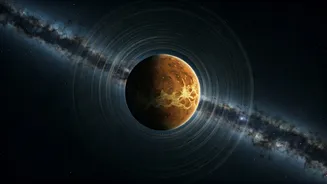





The Planet of Warped Time
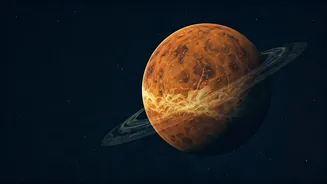
Welcome to Venus, a planet so strange it makes science fiction look tame. It’s often called Earth's "sister planet" due to its similar size and mass, but the similarities end there. [2, 8] Venus is a world of extremes, with surface temperatures hot enough
to melt lead and crushing atmospheric pressure. [2, 3] But perhaps its most bewildering feature is its relationship with time. The headline isn't an exaggeration: it takes Venus longer to complete one full rotation on its axis than it does to complete one entire orbit around the Sun. [3] This creates a situation unlike anywhere else in our solar system, where a single day stretches on for longer than a whole year. [17]
Breaking Down the Bizarre Numbers
Let's put this into perspective using Earth terms. A year on Venus—the time it takes to circle the Sun—is approximately 225 Earth days. [2, 3] Now, for the day. A single rotation of Venus on its axis, known as a sidereal day, takes a staggering 243 Earth days. [3, 7] So, by the time Venus has completed a full spin, it has already completed its journey around the Sun and is well into the next year. It’s a place where the calendar year literally finishes before the day is done. [17] This makes Venus's rotation the slowest of any major planet in the solar system. [5, 8]
A Tale of Two Kinds of Day
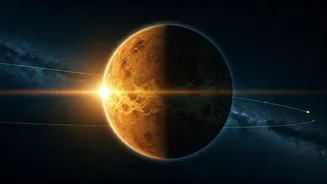
To fully grasp the weirdness, it's important to understand the difference between a sidereal day and a solar day. A sidereal day is a planet's rotation relative to the distant stars (243 Earth days for Venus). [9, 12] A solar day is the time it takes for the Sun to return to the same position in the sky, which is what we typically think of as a 'day'. [9, 12] Because Venus rotates backwards (retrograde) while orbiting the Sun, these two values are wildly different. [5, 7] A solar day on Venus—from one sunrise to the next—is about 117 Earth days. [2, 5] This means you would experience roughly two months of daylight followed by two months of darkness, all while the Sun rises in the west and sets in the east. [5, 7]
Why the Slow, Backward Spin?
Scientists have two main theories for Venus's slow, retrograde rotation. The first popular theory suggests a colossal impact in the distant past. [3, 7] Early in the solar system's formation, a massive object may have collided with Venus, knocking it off its original orientation and sending it into a slow, backward spin. [3, 11] A second theory points to the planet's incredibly thick atmosphere. This dense, heavy atmosphere, about 93 times more massive than Earth's, may create powerful tidal forces that drag on the surface. [4, 6] Over billions of years, this atmospheric friction could have acted like a brake, slowing the planet's rotation to its current crawl and even reversing it. [4, 5]
An Atmosphere That Fights the Sun
The relationship between Venus's atmosphere and its rotation is a fascinating battle of cosmic forces. The Sun's immense gravity constantly tries to tidally lock Venus, which would force the planet to show the same face to the Sun continuously, similar to how our Moon is locked with Earth. [4, 16] If this happened, a day would perfectly match its year. However, the Sun's energy also heats Venus's atmosphere, creating violent, super-rotating winds. [4, 9] This turbulent atmosphere pushes against the planet's surface, providing a counteracting force that prevents the Sun from achieving a full tidal lock. [16] In a strange paradox, the Sun itself powers the very mechanism that defies its gravitational grip. [4]