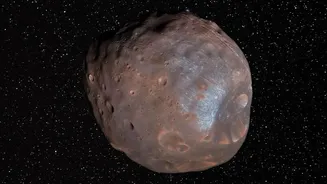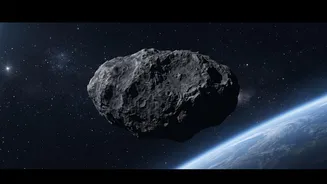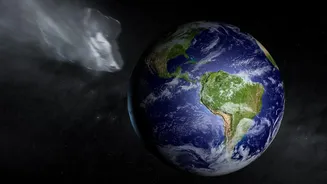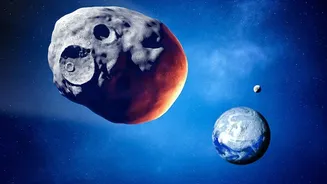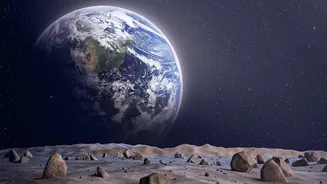

Look up at the night sky, and you’ll see one familiar, faithful companion: the Moon. But what if I told you Earth often has more than one? Our planet has a temporary visitor, a 'mini-moon' called 2026 QQ8, and its time with us is nearly up.
What Exactly is a 'Mini-Moon'?
The term 'mini-moon'
isn't an official astronomical designation, but it's a wonderfully descriptive name for what scientists call a Temporarily Captured Object, or TCO. These are typically small asteroids, often no bigger than a car or a washing machine, that get caught in Earth's gravitational pull for a short time. Unlike our permanent Moon, which has been with us for billions of years, mini-moons are fleeting guests. Their orbits are often chaotic and looping, and they usually only stick around for a few months before the Sun's stronger gravity pulls them away, sending them back on their journey through the solar system. While a few have been officially confirmed over the years, simulations suggest that at any given moment, Earth is likely hosting at least one of these tiny companions.
Meet Our Temporary Companion: 2026 QQ8
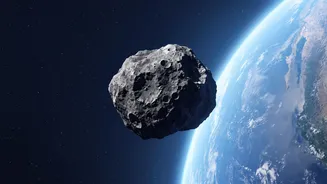
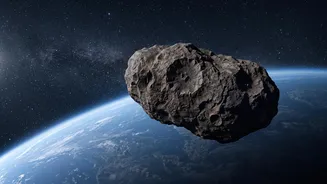
The latest visitor to our celestial neighbourhood is 2026 QQ8. This small asteroid, estimated to be just 1.4 to 3 meters (about 5 to 10 feet) in diameter, was first spotted in August 2026 by Hungarian astronomer Krisztián Sárneczky. Initially, astronomers had to confirm it wasn't a piece of old space debris, a common challenge when observing such faint, small objects. After careful observation, the International Astronomical Union's Minor Planet Center confirmed its natural origin and gave it its official name. 2026 QQ8 is believed to have been captured by Earth's gravity back in April 2026. Despite being our 'second moon', you won't be able to see it without powerful telescopes; it's incredibly small and currently more than 1.5 times farther away than our main Moon.
A Cosmic Dance of Gravity
How does a wandering asteroid become a mini-moon? It's a delicate gravitational dance. For capture to happen, an asteroid has to approach Earth at a relatively slow speed and at just the right angle. The capture often happens near specific points in space where the gravitational forces of the Sun and Earth are in a kind of equilibrium, known as Lagrange points. If an asteroid passes through this region, Earth's gravity can become the dominant force, pulling the object into a temporary, unstable orbit. This is very different from our Moon's stable, nearly circular path. A mini-moon's orbit is often a complex, looping pattern, as it is simultaneously influenced by the Earth, our Moon, and the Sun. It’s a cosmic balancing act that never lasts long.
When Is 'Soon' and Where Is It Going?
The headline says 2026 QQ8 could escape 'soon', and in cosmic terms, that means it's just around the corner. According to the latest orbital calculations, our tiny companion is expected to break free from Earth's gravity sometime between December 2026 and January 2027. This isn't a violent escape, but a natural progression. As 2026 QQ8 continues on its looping path, it will reach a point where the Sun's gravitational tug becomes stronger than Earth's, gently pulling it away. It will then continue on its own orbit around the Sun. And this isn't a final goodbye. Its solar orbit will bring it back into Earth's vicinity in the future, with the next notable pass predicted for 2058.
Have We Had Mini-Moons Before?
While the discovery of a new mini-moon is always exciting, 2026 QQ8 is not the first. One of the most well-known prior examples was 2006 RH120, which orbited Earth for about a year between 2006 and 2007. More recently, an object named 2020 CD3, about the size of a small car, spent nearly three years as a mini-moon before departing in 2020. These confirmed discoveries are just the tip of the iceberg. Because they are so small and faint, most mini-moons likely come and go completely unnoticed. Each new discovery helps scientists better understand the population of near-Earth asteroids, some of which could even be fragments blasted off our own Moon by ancient impacts.