


The Constant Pull of Drag
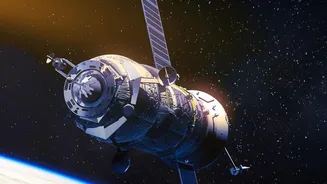
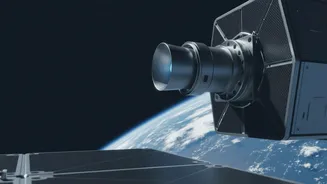
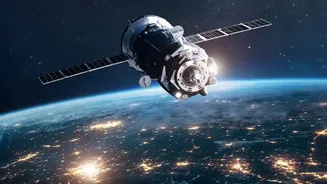
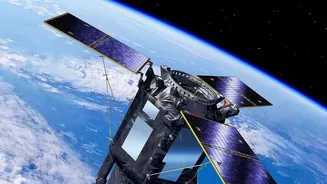
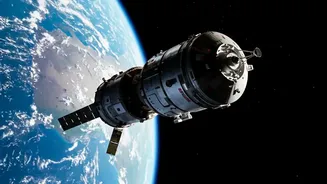
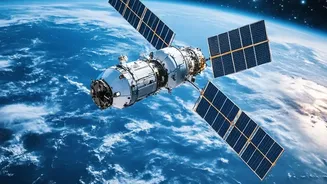
Low-Earth Orbit (LEO), and especially Very Low-Earth Orbit (VLEO) below 400 kilometers, is a highly desirable location for satellites. Being closer to the ground improves performance for Earth observation, providing higher-resolution images, and reduces
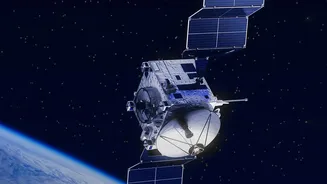
latency for communication networks. However, there's a catch. Even at these high altitudes, there are still traces of Earth's atmosphere. These stray air molecules create a small but constant drag on any spacecraft, slowing it down and causing its orbit to decay. To fight this, satellites must periodically fire their onboard thrusters to boost themselves back up. The problem is they can only carry a finite amount of propellant. Once the fuel runs out, the satellite's mission is effectively over, and it will eventually burn up in the atmosphere. This fundamental limitation dictates the operational lifespan of many valuable assets in space.
Turning a Problem into Propellant
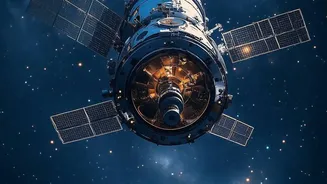
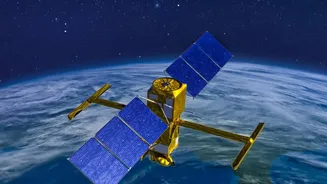
The breakthrough technology that promises to rewrite these rules is called air-breathing electric propulsion (ABEP). The concept is as elegant as it is ingenious: instead of carrying heavy propellant from Earth, a satellite would use the surrounding atmospheric particles as its fuel source. The same molecules that cause the drag are collected by a special intake, ionized, and then accelerated by an electric thruster to generate thrust. In theory, this allows a satellite to compensate for atmospheric drag indefinitely, as long as its solar panels can provide the necessary electrical power. This would transform satellite longevity from a question of fuel reserves to one of component durability, potentially enabling missions that last for years or even decades longer than is currently possible.
How Does It Actually Work?
An ABEP system essentially consists of two main parts: a collector and a thruster. The collector, or intake, is a specially designed inlet that scoops up the sparse atmospheric particles — mostly nitrogen and oxygen — as the satellite speeds along its orbit. These collected particles are then channeled into an electric propulsion system, such as a Hall-effect or gridded ion thruster. Inside the thruster, the gas is ionized (given an electric charge) and then expelled at extremely high velocity by electric and magnetic fields, producing thrust. The concept has been around since the 1960s, but recent advancements in electric propulsion and materials science have brought it from theory to reality. Research groups and companies like the European Space Agency (ESA), and US firms like Phase Four working with DARPA, have successfully demonstrated prototype systems in ground-based vacuum chambers that simulate the VLEO environment.
The Dawn of 'Infinite' Orbits
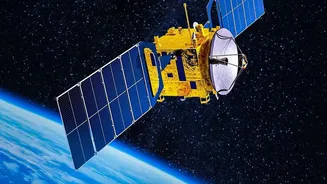
The implications of mastering this technology are immense. It would enable a new class of long-duration missions in VLEO, an orbital region that has been historically difficult to operate in. This opens the door for persistent, high-resolution surveillance for military and civilian purposes, ultra-low latency communication networks, and more detailed scientific monitoring of our planet. Furthermore, it promotes a more sustainable use of space. Satellites operating at these lower altitudes will naturally de-orbit and burn up much faster at the end of their lives, helping to mitigate the growing problem of space debris. By eliminating the need for vast quantities of onboard propellant, satellites could also be made smaller, lighter, and cheaper to launch, further democratizing access to space.
Challenges on the Horizon
While the promise of ABEP is significant, several technical hurdles remain before we see fleets of air-breathing satellites circling the globe. Designing an intake that can efficiently collect enough particles in such a rarefied environment without creating excessive drag is a major challenge. The thrusters also need to be robust enough to handle the corrosive effects of atomic oxygen, which is highly reactive at these altitudes and can degrade system components over time. Finally, the entire system must be incredibly power-efficient to operate continuously using only the electricity generated by the satellite's solar arrays. Ongoing projects, such as DARPA's Otter program and ESA-supported initiatives, are actively working to solve these issues, transitioning the technology from laboratory prototypes to flight-ready hardware.