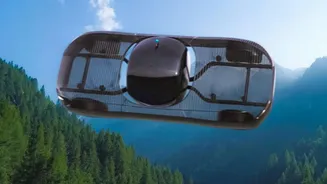








Decoding the Flying Taxis
So, what are eVTOLs? Think of them as a hybrid of a helicopter and a drone, designed for city life. They are fully electric, making them significantly quieter and more eco-friendly than traditional helicopters. Their key feature is the ability to take
off and land vertically, eliminating the need for long runways. This allows them to operate from small, designated pads called vertiports, which can be located on rooftops or in compact urban spaces. These aircraft are engineered for safety, with multiple rotors and redundant battery systems to ensure they can land securely even if a component fails. Capable of carrying a pilot and typically four to six passengers, they are built for short, rapid flights within and between cities.
The Race to India's Skies
Several major players are already laying the groundwork for eVTOL services in India, targeting a launch within the next few years. InterGlobe Enterprises, the parent company of IndiGo, has partnered with US-based Archer Aviation to bring an all-electric air taxi service to India, potentially as early as 2026. Their plan involves a fleet of up to 200 of Archer's 'Midnight' aircraft, initially focusing on routes in Delhi, Mumbai, and Bengaluru. Another key operator, Blade India, which already runs helicopter services, is also preparing for an electric future. The company has agreements to purchase hundreds of eVTOLs from manufacturers like Eve Air Mobility and Jaunt Air Mobility, with plans to begin operations around 2027. Homegrown startups like Sarla Aviation are also entering the fray, developing their own aircraft and partnering with airports.
From Hours to Minutes
The most compelling advantage of eVTOLs is the dramatic time savings. The proposed service between Delhi's Connaught Place and Gurugram could cut a 60-to-90-minute car ride down to just seven minutes. Similarly, a trip from Bengaluru's city centre to the airport, which often takes over an hour by road, could be completed in under 20 minutes. Initially, these services will come at a premium. A flight from Connaught Place to Gurugram is estimated to cost between ₹2,000 and ₹3,000. However, operators believe that as the technology matures and operations scale up, prices could eventually become competitive with premium ground-based ride-sharing services. The goal is to democratize short-haul air travel, making it an accessible option for daily commuters, not just a luxury experience.
Not So Fast: The Ground Realities
Despite the exciting potential, the path to a sky full of air taxis is paved with challenges. The most significant hurdle is infrastructure. A robust network of vertiports, complete with charging stations, needs to be built across congested cities—a complex and expensive undertaking. Air traffic management is another critical issue. Integrating thousands of low-flying aircraft into already busy urban airspace requires a sophisticated new system to ensure safety and prevent collisions. Public acceptance and safety are paramount. While designed to be safer than helicopters, these new aircraft must earn public trust. Furthermore, battery technology, while rapidly advancing, still presents limitations on range and the time required for recharging between flights.
Clearing the Skies for Takeoff
Ultimately, the success of eVTOLs in India hinges on regulation. The Directorate General of Civil Aviation (DGCA) is actively working on a comprehensive framework for what is known as Advanced Air Mobility (AAM). This involves creating new rules for everything from aircraft certification and pilot licensing to vertiport standards and operational guidelines. The DGCA has already issued guidelines for vertiports and the airworthiness of eVTOL aircraft, signalling a methodical approach to integrating this technology safely into the national airspace. Before any commercial service can launch, each aircraft model must receive type certification from the DGCA, a rigorous process to ensure it meets India's safety standards.