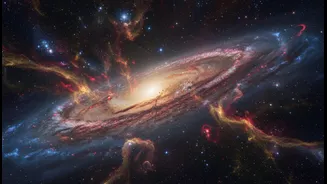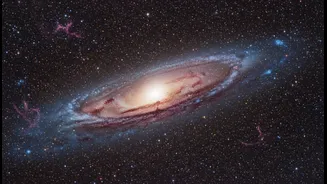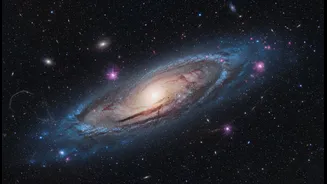






The Universe’s Dusty Veil
Before we get to the technology, let’s talk about the problem: dust. Cosmic dust isn't like the stuff on your bookshelves. It's composed of tiny particles of silicates, carbon, and other elements forged inside stars and spewed out into space. While these
grains are minuscule—often smaller than the wavelength of visible light—they form vast, opaque clouds throughout galaxies. For telescopes like Hubble, which primarily sees in visible and ultraviolet light, this dust is a frustrating veil. It blocks starlight, hiding some of the most fascinating events in the universe, such as the birth of new stars and the violent collisions of galaxies. Entire galactic cores can be completely obscured, leaving astronomers with an incomplete picture. For decades, what lay behind these dusty curtains was largely a matter of speculation.
Seeing the Unseen with Infrared
This is where infrared light comes in. Think of it like this: visible light has a short wavelength that easily gets blocked or scattered by particles of a similar size, much like how thick smoke can block the view across a room. Infrared light, however, has a longer wavelength. These longer waves can effectively slip past the tiny dust grains without being absorbed or scattered. As a result, a telescope designed to detect infrared light can see right through the dust clouds that are opaque to other observatories. It’s a cosmic superpower that allows JWST to lift the veil. Furthermore, many of the most interesting objects, like newly forming stars and the glowing hearts of active galaxies, radiate most of their energy as heat, which is emitted as infrared light. So, JWST not only sees through the dust, it also sees the very things the dust was hiding.
Webb’s High-Tech Eyes
The James Webb Space Telescope is equipped with a suite of four powerful instruments, but two are key to its dust-penetrating vision: the Near-Infrared Camera (NIRCam) and the Mid-Infrared Instrument (MIRI). NIRCam is Webb's primary imager, capturing the near-infrared spectrum from 0.6 to 5 microns. This range is perfect for detecting light from the earliest stars and galaxies. MIRI, on the other hand, sees in the longer mid-infrared wavelengths, from 5 to 28 microns. To do this, it must be kept incredibly cold—just a few degrees above absolute zero—so its own heat doesn't interfere with the faint signals from deep space. Together, NIRCam and MIRI provide a comprehensive view. NIRCam can pierce through thinner dust to see stars, while MIRI can penetrate even the densest regions and detect the glow of the dust itself, revealing hidden structures.
Unmasking Galactic Collisions
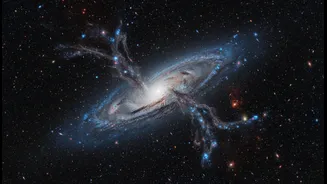
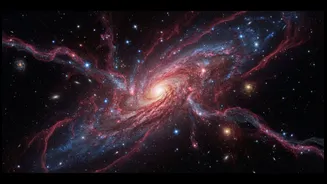
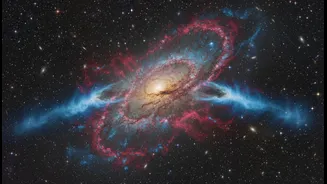
Galaxy mergers are among the most dramatic events in the universe, and they are often intensely dusty affairs. As two galaxies collide over millions of years, their gas and dust clouds are compressed, triggering furious bursts of star formation. These stellar nurseries are shrouded in the very material that fuels them, making them nearly invisible to optical telescopes. This is where JWST's infrared vision becomes revolutionary. In a recent observation of Centaurus A, a nearby galaxy known to be the result of a past merger, Webb’s instruments peered through the thick dust lanes that have long obscured its core. The observations, particularly from MIRI, revealed unexpected and complex dusty structures, including a strange parallelogram-shaped feature and an S-shaped warp, offering new clues about how the merger and the galaxy's central supermassive black hole have shaped its evolution. By cutting through the dust, JWST allows astronomers to study the mechanics of starbursts and black hole activity at the heart of these cosmic trainwrecks in unprecedented detail.
A New Era of Discovery
The ability to see through cosmic dust is changing our understanding of the universe. It’s not just about galaxy mergers. Webb is using this same capability to look deep into stellar nurseries within our own Milky Way, revealing newborn stars that were previously hidden. It's analyzing the composition of dust disks around young stars where planets are forming, and even peering into the atmospheres of exoplanets. The technology on board JWST isn't just an upgrade; it's a paradigm shift. By translating invisible light into stunning, data-rich images, the telescope is solving old mysteries and, more importantly, uncovering new questions. Each image that pierces a dusty shroud demonstrates that the hidden universe is often more complex and more beautiful than we ever imagined.