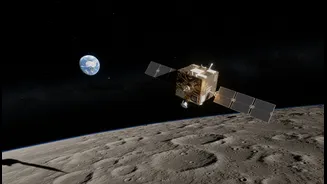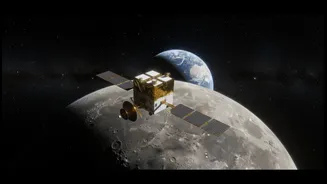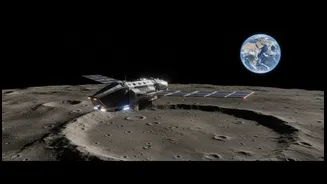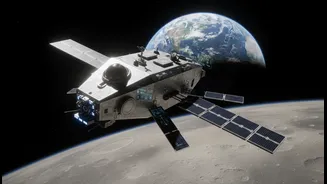





What is CAPSTONE?
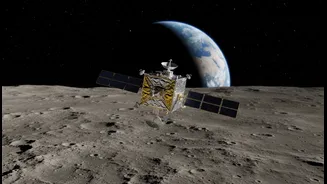
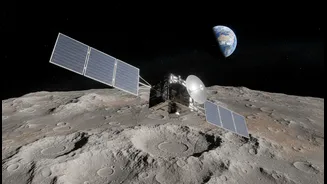
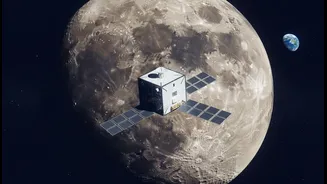
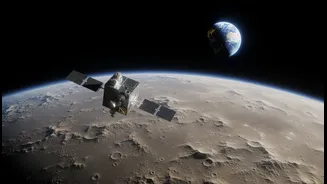
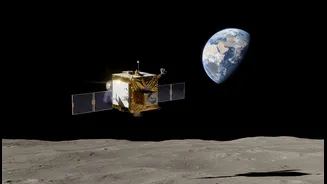
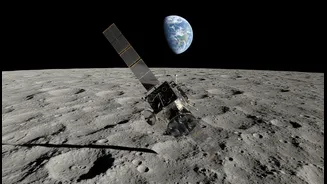
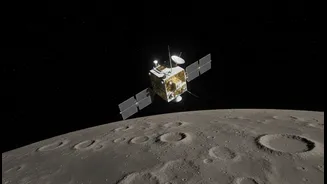
CAPSTONE, short for Cislunar Autonomous Positioning System Technology Operations and Navigation Experiment, is a 55-pound CubeSat launched in June 2022. Owned and operated by commercial partner Advanced Space for NASA, its primary job was not to be a permanent
fixture, but a trailblazer. Think of it as a scout sent ahead to map treacherous new territory before the main expedition arrives. Its mission was to fly a very specific, never-before-used path around the Moon, testing its stability and demonstrating new navigation technologies. After successfully completing its primary and extended goals, NASA concluded its activities with the mission in June 2026, though the spacecraft continues to operate as a testbed.
A Pathfinder in a Unique Orbit
The territory CAPSTONE explored is a special path called a near-rectilinear halo orbit, or NRHO. Unlike the low lunar orbits of the Apollo era, which are deep in the Moon's gravity well, an NRHO is a highly elongated orbit balanced precisely between the gravity of the Earth and the Moon. This unique position offers incredible advantages: it’s remarkably stable, requiring very little fuel for a spacecraft to maintain its position over the long term. It also provides a continuous line-of-sight to Earth for communications. CAPSTONE's job was to be the first-ever spacecraft to fly this orbit, verifying that the complex mathematical models predicting its stability were correct in the real world. By doing so, it confirmed the power and propulsion requirements for future missions, significantly reducing risk for the ambitious Artemis program.
Technology Test vs. Space Station
This is the core of the matter. CAPSTONE is a technology demonstrator. Its purpose was to prove that the NRHO was a viable and safe place to operate. It was also designed to test an innovative autonomous navigation system, allowing spacecraft to determine their position relative to another orbiter—in this case, NASA's Lunar Reconnaissance Orbiter (LRO)—without constantly relying on signals from Earth. This is fundamentally different from being a space station. A station is a destination, a habitat, a laboratory, and a staging point. A technology test is a temporary mission designed to gather data and validate a concept. CAPSTONE was never intended to be a permanent outpost; it was the advance surveyor checking the foundation before the builders arrive.
Paving the Way for a Lunar Outpost
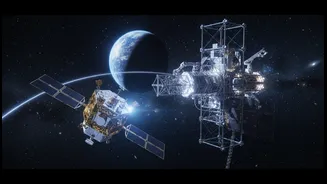
The 'station' in this equation was intended to be the Lunar Gateway, a multi-national project to build a small space station in the same NRHO that CAPSTONE validated. The Gateway was envisioned as a docking port and staging area for astronauts traveling to the lunar surface as part of the Artemis program. CAPSTONE's successful mission directly informed the requirements for Gateway, proving that the orbit was as stable and efficient as hoped. However, in a strategic shift announced in early 2026, NASA cancelled the Gateway project to redirect resources toward accelerating the development of a sustainable lunar surface base. While the Gateway itself is no longer proceeding, the orbital mechanics that CAPSTONE proved remain critically important for any future infrastructure in cislunar space.
Why This Distinction Matters
Confusing a technology test with an operational station can lead to misunderstandings about program progress and capabilities. CAPSTONE’s success was monumental, but it was a success in data collection and risk reduction. It provided the 'ground truth' that future, more complex spacecraft and missions will rely upon. For engineers, mission planners, and space enthusiasts, appreciating this difference is key. It highlights the methodical, step-by-step process of space exploration. We don't just build a station; we first send a scout to ensure the location is safe, the route is clear, and the technology is ready. CAPSTONE performed its job perfectly, providing the confidence needed to take the next giant leaps in our return to the Moon, even as the specific shape of that future evolves.