






A Sudden Burst of Light
In late 2019, astronomers noticed something strange. A galaxy named SDSS1335+0728, located in the Virgo constellation, suddenly began to shine brighter than ever before. For decades, it had been a quiet, unremarkable patch in the sky. But data from the Zwicky
Transient Facility in California showed its core was dramatically brightening. This wasn't a fleeting event like a star exploding, which fades over days or months. This galaxy has continued to brighten for more than four years, signalling a fundamental and long-term change.
What Does 'Activating' Mean?
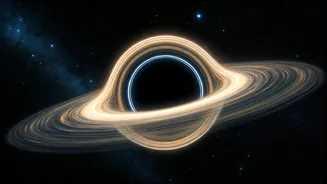
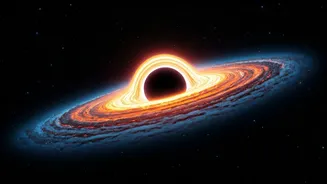
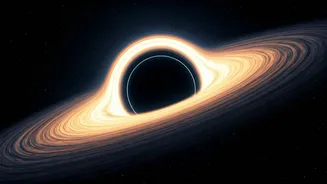
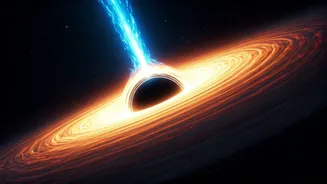
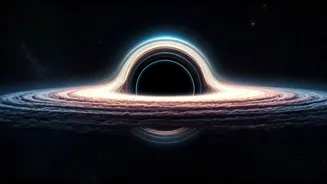
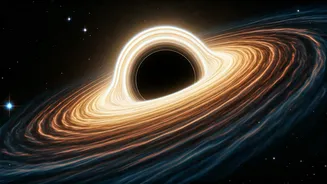
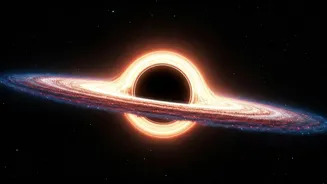
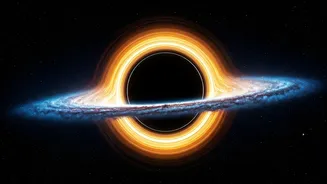
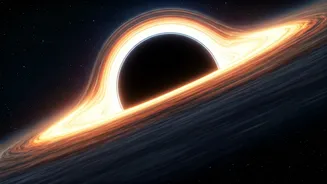
Supermassive black holes, which can be millions or billions of times the mass of our Sun, sit at the center of most large galaxies, including our own Milky Way. Most of the time, they are 'sleeping' or dormant, making them difficult to see directly. A black hole 'activates' or 'wakes up' when it begins to feast on a large amount of gas and dust from its surroundings. This material forms a swirling, superheated disc around the black hole called an accretion disc. As the material is pulled in by immense gravitational forces, it releases a tremendous amount of energy, causing the galaxy's center to become intensely luminous. This bright, energetic core is known as an Active Galactic Nucleus, or AGN.
Catching a Cosmic Monster in the Act
To understand what was happening, an international team of astronomers used a combination of archival data and new observations from multiple powerful telescopes, including the European Southern Observatory's Very Large Telescope. They compared data from before and after the brightening began in December 2019. The team found the galaxy is now radiating significantly more energy in ultraviolet, optical, and infrared light. Then, in February 2024, it also began to emit X-rays, a sign of even higher-energy processes close to the black hole. According to lead researcher Paula Sánchez Sáez, this behaviour is unprecedented. While astronomers have seen galaxies switch from inactive to active before, this is the first time the process of activation has been caught in real-time.
A New Window into the Universe
This discovery provides invaluable information on how black holes grow and how galaxies evolve. For years, the process of a black hole turning on was purely theoretical. Now, scientists can directly observe the steps involved. While the team is confident they are seeing an AGN ignite, they continue to monitor SDSS1335+0728 to rule out other, more exotic possibilities, such as an unusually slow and long-lasting tidal disruption event, where a star is torn apart by a black hole. Whatever the final conclusion, the event provides a unique laboratory for studying the life cycle of the universe's most massive objects.
Could It Happen in the Milky Way?
Naturally, this raises a question closer to home: could our own supermassive black hole, Sagittarius A, wake up? The black hole at the center of the Milky Way is currently dormant. Scientists believe this new observation in a distant galaxy could provide clues about the past and future of our own galactic core. While it's theoretically possible for Sagittarius A to become active if it encounters a large supply of gas, it is currently unclear how likely such an event would be. For now, this groundbreaking observation of a distant galaxy's awakening gives us a front-row seat to one of the most powerful and fundamental processes in the cosmos.