

More Than Just Walking With Sticks
At first glance, you might mistake Nordic walkers for skiers who’ve lost their way and their skis. But this Finnish-born activity is a highly effective, low-impact exercise that's gaining popularity worldwide. Originally developed as a summer training
method for cross-country skiers, Nordic walking uses specially designed poles to transform walking into a comprehensive workout. Unlike regular walking, which primarily uses the lower body, this technique incorporates the upper body, engaging up to 90% of your body's muscles compared to just 50% in a normal stroll. This increased muscle engagement means you burn more calories—estimates range from 20% to over 45% more than walking without poles—and get a better cardiovascular workout at the same pace.
The Upper-Body Advantage
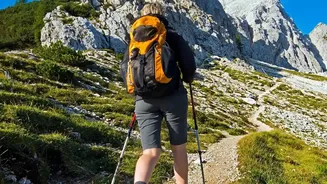
The secret to Nordic walking’s effectiveness lies in how you use the poles. It’s not about using them for support like trekking poles, which are designed for stability on uneven terrain. Instead, Nordic walking poles are used to propel yourself forward. With each step, you plant a pole behind you and push off, engaging the muscles in your arms, shoulders, chest, and back. This constant push-and-propel motion activates your triceps, biceps, latissimus dorsi (the large muscles in your back), and core abdominal muscles. Studies and experts note that this makes it an excellent choice for improving upper-body strength and endurance, something a simple walk just can't offer. It provides a well-rounded fitness boost, combining cardio with muscle toning in one single activity.
Mastering the Basic Technique
The technique is surprisingly intuitive and based on the natural rhythm of walking. The fundamental rule is to coordinate opposite arm and leg movement, just as you do when walking normally. As your left foot steps forward, your right arm swings forward with the pole. As your right foot moves, your left arm follows. The key is to plant the pole at an angle behind you and push off forcefully. Your arm should be relatively straight as you plant the pole and swing it back. As the pole moves behind you, you open your hand to let the pole swing forward, guided by the special glove-like strap. Maintaining an upright posture with a slight forward lean from the ankles is crucial. Look ahead, not down at your feet, and keep your shoulders relaxed.
Choosing the Right Gear
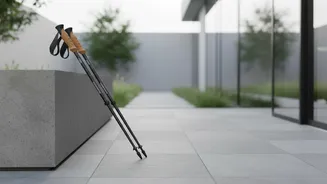
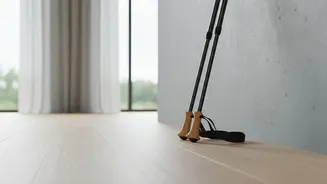
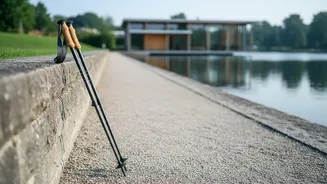
While the technique is important, so is the equipment. Nordic walking poles are distinct from trekking poles. They are lighter and feature a special strap system, often a glove-like attachment, that allows for the proper push-off technique. Using the wrong poles can make the technique difficult and negate many of the benefits. When selecting poles, length is critical. A common guideline is to hold the poles with the tips on the ground; your elbow should form a 90-degree angle. Alternatively, you can multiply your height in centimetres by 0.68 to get a good starting length. Poles come in fixed-length and adjustable varieties, and are made from materials like lightweight aluminium or even lighter carbon fibre. For beginners, adjustable poles are often a practical choice as you fine-tune your technique.
Why the Sudden Revival?
Nordic walking has been around for decades, but its recent surge in popularity can be attributed to a growing desire for accessible, effective, and low-impact forms of exercise. It's a workout that appeals to a wide range of age groups and fitness levels, from young adults to seniors. The low-impact nature of the activity makes it gentle on the joints, which is a major draw for older adults or those recovering from injuries. Furthermore, its proven benefits—including improved cardiovascular health, fat reduction, better posture, and enhanced stability—are backed by research, adding to its credibility. In a world looking for sustainable and enjoyable ways to stay active, Nordic walking delivers a powerful combination of fitness and simplicity.