
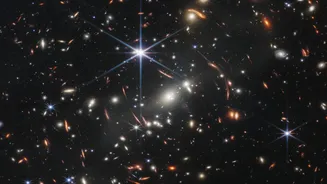
For decades, we’ve been told the universe is 13.8 billion years old. But what if it’s twice that age? A study from the University of Ottawa is challenging this cosmic cornerstone, suggesting our universe might be 26.7 billion years old.
The Universe's Standard Age
The accepted age
of the universe, 13.8 billion years, isn't a random guess. It's the bedrock of the standard model of cosmology, known as the Lambda-CDM model. This model explains how the universe evolved from the hot, dense state of the Big Bang. Scientists arrive at this age by measuring the expansion of the universe. They observe the light from distant galaxies, which gets stretched into longer, redder wavelengths as the space between us and them expands. This phenomenon, called redshift, acts like a cosmic clock, allowing astronomers to calculate how long the universe has been expanding. The Lambda-CDM model has been incredibly successful, explaining a wide range of cosmic observations, from the faint afterglow of the Big Bang to the large-scale structure of galaxies.
A New Challenger Appears
The new study, led by Rajendra Gupta, an adjunct professor of physics at the University of Ottawa, proposes a radical rethink. His model estimates the universe is actually 26.7 billion years old. This isn't just a minor adjustment; it’s a fundamental challenge to the standard timeline. The motivation for this new model comes from recent discoveries by the James Webb Space Telescope (JWST). The JWST has spotted galaxies in the very early universe that are surprisingly massive and mature. Under the 13.8-billion-year timeline, these 'impossible early galaxies' appear to have formed too quickly, creating a puzzle for astrophysicists. Gupta's model suggests a simple solution: the universe is much older, giving these galaxies plenty of time to develop.
Rethinking Redshift with 'Tired Light'
To double the age of the universe, Gupta’s model revisits a century-old idea called 'tired light'. First proposed by Fritz Zwicky in 1929, this theory suggests that redshift isn't only caused by the expansion of space. It proposes that photons—particles of light—gradually lose energy as they travel across billions of light-years. This energy loss would also cause light to shift towards the red end of the spectrum. The standard model largely dismissed tired light because it couldn't explain several key observations, such as the uniform temperature of the cosmic microwave background. However, Gupta's work doesn't simply replace expansion with tired light; it combines the two, suggesting both effects contribute to the redshift we see.
Changing Rules for a Changing Cosmos
The other key component of Gupta's model is the idea of 'Covarying Coupling Constants' (CCC). In simple terms, this means that the fundamental forces of nature, which physicists believe are constant, might actually change over cosmic time. This is combined with the 'Tired Light' theory into a hybrid model known as CCC+TL. By allowing these physical constants to evolve, the model can explain cosmic phenomena without the need for two mysterious ingredients that make up 95% of the standard model: dark matter and dark energy. In this new framework, the effects we attribute to dark matter (the invisible glue holding galaxies together) and dark energy (the force accelerating cosmic expansion) could instead be the result of the laws of physics themselves changing over aeons.
What Does the Scientific Community Think?
It is crucial to understand that the CCC+TL model is a provocative and highly unconventional proposal. The standard Lambda-CDM model remains the dominant and most widely accepted framework in cosmology, backed by decades of overwhelming evidence. Theories like 'tired light' have been repeatedly tested and have failed to explain observations that the expansion model explains perfectly, such as the apparent time dilation in supernovae explosions and the surface brightness of distant galaxies. Gupta's hybrid model is new and is undergoing scrutiny. While some of its predictions reportedly match observations, other parts are still under peer review. For it to replace the standard model, it will need to consistently explain all major cosmic observations at least as well as the current theory.