
A Glimpse of Our Sun’s Future
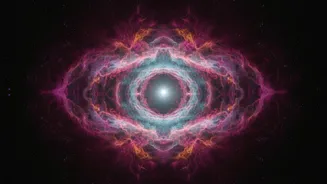
Located about 650 light-years away, the Helix Nebula is what’s known as a planetary nebula. Despite the name, it has nothing to do with planets. Instead, it’s the beautiful, glowing remnant of a star much like our own Sun at the end of its life. After
exhausting its fuel, the star shed its outer layers of gas into space. The central core of that star, a super-hot white dwarf, now irradiates this expanding gas, causing it to glow. For astronomers, studying the Helix Nebula is like getting a preview of the eventual fate of our own solar system, billions of years from now. It’s one of the closest and most striking examples of a star’s final act.
What Are These 'Comet-Like Knots'?
While astronomers have known about these strange structures for decades, Webb’s powerful infrared vision has brought them into sharp, unprecedented focus. The new image reveals thousands of these features, which are called “cometary knots” because their dense, glowing heads and long, streaming tails resemble comets. But these are not comets. They are colossal structures of gas and dust. Each knot's head can be twice the size of our entire solar system, with tails stretching for 100 billion miles. Their origin has long been a puzzle, but the leading theory is that they form when hot, fast winds from the central dying star slam into cooler, denser clumps of gas that the star ejected thousands of years earlier. This cosmic collision fragments the gas clouds into the tadpole-shaped knots we see today.
Survivors of a Stellar Death
Think of the knots not as newcomers, but as survivors. They are dense, resilient pockets of molecular gas that have managed to withstand the intense radiation and powerful stellar winds blasting out from the star’s core. In fact, the dense heads of the knots act like shields, protecting the gas streaming away behind them, which forms the long tails. While they look delicate, each knot has a mass comparable to that of Earth. Webb’s image shows the incredible detail of how this process unfolds, tracing how the star’s recycled material is sculpted and distributed back into the cosmos.
Why This Discovery Matters
Beyond the sheer beauty of the image, this detailed view helps scientists understand one of the most fundamental processes in the universe: stellar recycling. Dying stars like this one seed the interstellar medium with heavy elements and complex molecules. Within the cool, protected tails of these cometary knots, new molecules can form, sheltered from the harsh radiation of the central star. This is the very raw material from which the next generation of stars and, eventually, planets will be born. By studying how these structures form and survive, astronomers gain crucial insights into the life cycle of stars and the chemical origins of the universe. It helps answer questions about where the building blocks of worlds like our own come from, showing us that even in death, stars provide the ingredients for new life.