
A Childhood Shaped by War
Luka Modrić's story begins not on a pristine football pitch, but amidst the turmoil of the Croatian War of Independence. Born in 1985, his early life in the hamlet of Modrići was shattered when conflict erupted. At just six years old, his world was turned
upside down. The most profound tragedy struck in December 1991, when his beloved grandfather, also named Luka, was killed by Serbian forces while herding his animals. This event forced the Modrić family to flee their home, which was later burned to the ground. They became refugees, seeking shelter in the city of Zadar. For seven years, their home was a series of crowded refugee hotels, often without basic necessities like electricity or running water. It was in these trying circumstances, with the sound of bombs and sirens as a constant backdrop, that football became his escape.
Football in a Parking Lot
While his family grappled with the uncertainty of war, Luka found solace and purpose with a ball at his feet. The parking lot of the Hotel Kolovare became his first training ground. Against the concrete walls and between parked cars, he spent countless hours honing the skills that would later define him: the exceptional close control, the balance, and the vision. His father, Stipe, who had joined the Croatian Army, used what little money the family had to enroll his son in a local sporting academy. Despite the clear talent, Modrić faced constant rejection for his slight, lightweight frame. Scouts from Hajduk Split, a major regional club, dismissed him as being 'too small and too weak' to ever make it as a professional. It was a judgment that would follow him for years, but one that only fueled his determination.
Forged in the Bosnian League
After being signed by Dinamo Zagreb in 2002, the club decided to toughen him up. At 18, he was sent on loan to Zrinjski Mostar in the notoriously physical Bosnian Premier League. It was a trial by fire, a place where technical skill often took a backseat to brute strength. Yet, Modrić didn't just survive; he thrived. He was named the league's Player of the Year. He later reflected on the experience, stating, 'someone who can play in the Bosnian league can play anywhere'. This loan spell was pivotal, proving to himself and others that his technical brilliance could overcome any perceived physical disadvantage. He returned to Dinamo Zagreb a more complete and resilient player, ready to take on the Croatian league.
Conquering Europe
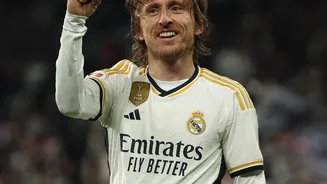
Modrić's success at Dinamo Zagreb, where he won three league titles, eventually earned him a move to the English Premier League with Tottenham Hotspur in 2008. After a period of adaptation, he became the creative heartbeat of the team, guiding them to their first Champions League appearance in nearly 50 years. His performances caught the eye of Real Madrid, and in 2012, he made the career-defining move to the Spanish giants. At Madrid, he evolved into one of the world's best midfielders, a vital cog in a team that achieved historic success. He was the conductor of the midfield, controlling the tempo of games and playing a crucial role in winning an incredible four Champions League titles in five seasons.
The Pinnacle: World Cup and Ballon d'Or
The year 2018 marked the apex of Luka Modrić's career. He captained Croatia on a historic, underdog run to the FIFA World Cup final in Russia. Though they narrowly lost to France, Modrić's leadership and spellbinding performances earned him the Golden Ball as the tournament's best player. This incredible achievement, combined with another Champions League victory with Real Madrid, propelled him to football's highest individual honor. In December 2018, he was awarded the Ballon d'Or, breaking the decade-long duopoly of Lionel Messi and Cristiano Ronaldo. It was the ultimate validation for a player who had been counted out so many times.