






A New Look at a Galactic Powerhouse
The James Webb Space Telescope (JWST) recently celebrated its fourth anniversary of science operations by releasing a spectacular new view of Centaurus A. This galaxy, located a relatively close 11 million light-years away, is a hotbed of scientific debate
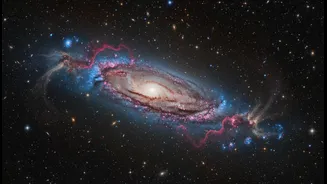
and cosmic activity. Its peculiar shape is the result of a colossal merger between two galaxies billions of years ago, which left it with an abundance of gas and dust to fuel intense star formation. Webb's infrared instruments cut through the obscuring dust that hides the galaxy's core in visible light, revealing a densely packed tapestry of millions of individual stars. This allows astronomers to perform a kind of 'galactic archaeology,' studying each star to piece together a timeline of the galaxy's violent and beautiful history. The image also highlights strange dust structures, including a perplexing 'S' shape that scientists are now working to understand.
The Heart of a Galactic Collision
Webb's powerful gaze didn't just capture the stars; it also provided new insights into the supermassive black hole at Centaurus A's core. The data reveals fast-moving jets of ionised gas flowing outward, driven by the black hole's immense gravitational pull and activity. This process of a black hole eating matter and expelling energy shapes the entire galaxy around it. By combining data from its Near-Infrared Camera (NIRCam) and Mid-Infrared Instrument (MIRI), Webb provides a multi-layered view. The NIRCam view, which at first appears grainy, is actually resolving countless individual stars, while MIRI highlights the glowing, intricate shapes of cosmic dust. Together, they transform our view of Centaurus A from a static object into a dynamic, evolving system, a living record of cosmic history.
Hubble's Dazzling Star-Spangled Cluster
Not to be outdone, the venerable Hubble Space Telescope also delivered a breathtaking new portrait in early July. To mark a recent anniversary, NASA released a stunning image of Messier 3, an ancient and massive globular cluster containing over 500,000 stars. Globular clusters are spherical collections of old stars, all born from the same cloud of gas at roughly the same time. This makes them pristine laboratories for studying the early history of our Milky Way galaxy. The new image of Messier 3, blazing with red, white, and blue stars, is part of a larger survey of the Milky Way's globular clusters, helping astronomers build a more complete timeline of our galaxy's formation. It's a powerful reminder that even after more than three decades, Hubble continues to be a cornerstone of modern astronomy.
A Cosmic Nursery in the Large Magellanic Cloud
Hubble also recently captured a vibrant image of LH 95, a stellar nursery located in the Large Magellanic Cloud, a dwarf galaxy that orbits our own Milky Way. This region is a hive of activity where young, low-mass stars are forming alongside massive blue giants. The image glows with crimson light, a tell-tale sign of hydrogen-alpha emissions, which helps astronomers pinpoint the youngest stars as they emerge from their gaseous cocoons. By studying regions like LH 95, researchers can better understand the processes of star formation. The data indicates that many of the infant stars in this nursery are still actively gathering material from the disks of gas and dust that surround them, offering a direct look at the early stages of stellar and planetary system development.