



Catch the Last of the Perseids
The famous Perseid meteor shower peaked around August 12-13, but its activity continues until August 24. While the number of shooting stars has decreased, you can still catch bright, lingering meteors in the late-night hours. For your best chance, find
a spot away from city lights, let your eyes adjust to the darkness for about 20 minutes, and look towards the northeast. The hours after midnight are typically the most productive, as the shower's radiant point in the constellation Perseus climbs higher in the sky.
A Parade of Morning Planets
The second half of August features a beautiful lineup of planets in the pre-dawn sky. Look to the east and south about an hour before sunrise to see a celestial procession. Reddish Mars will be climbing in the east, while yellowish Saturn will be visible in the south. Very bright Jupiter is also making its appearance, rising higher each morning in the east as the month progresses. While four planets are visible to the naked eye, a full 'planet parade' including Uranus and Neptune has been occurring, though these two require binoculars. This alignment will remain visible for several days.
The Dazzling Evening Star: Venus
You can't miss Venus this month. The brilliant planet dominates the western sky shortly after sunset. On August 15, Venus reached its greatest eastern elongation, meaning it was at its highest point above the horizon for its current evening appearance. Throughout the rest of August, it will continue to shine brightly as the 'Evening Star'. On the evenings of August 16 and 17, the waxing crescent moon hangs near Venus and the bright star Spica, making for a lovely celestial gathering.
Find the Summer Triangle
High overhead in the evening sky is one of the most recognizable star patterns of the season: the Summer Triangle. This is not a constellation, but an asterism formed by three brilliant stars from three different constellations. The brightest is the blue-white star Vega, which is nearly directly overhead in the evening. The other two corners are marked by Deneb, which lies to the east, and Altair, located to the south. This giant triangle is easy to spot even from light-polluted areas and serves as a great starting point for exploring the night sky. If you're in a dark location, you'll see the hazy band of the Milky Way running right through the Triangle.
Scorpius and Its Bright Heart
Look toward the south-southwest after dusk to find the distinctive, J-shaped constellation of Scorpius the Scorpion. Its brightest star is Antares, a reddish supergiant often called the 'heart of the scorpion'. On August 21, the waxing gibbous moon will be situated right in the middle of Scorpius, creating a beautiful sight. Nearby, you can also spot the 'Teapot' of Sagittarius, another famous asterism that lies in the direction of our Milky Way galaxy's center.
Watch the Moon's Journey
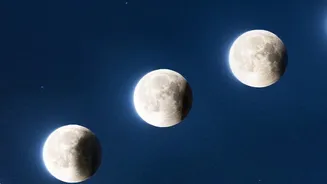
The Moon itself is a fantastic object to observe. After the new moon on August 12, it has been growing, or waxing. It reaches its first quarter on August 20, appearing as a half-moon high in the sky at sundown. A noteworthy event occurs on the overnight of August 27-28: a deep partial lunar eclipse will be visible from many locations. A full moon will follow on August 28. On the evenings of August 29 and 30, the moon will appear close to the planet Saturn.