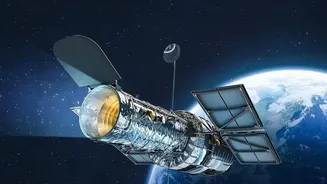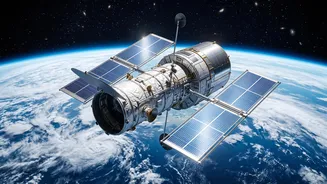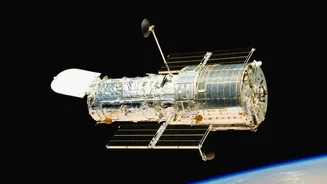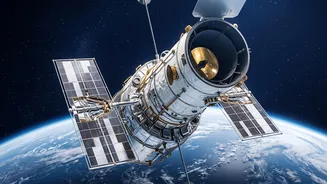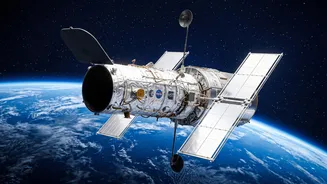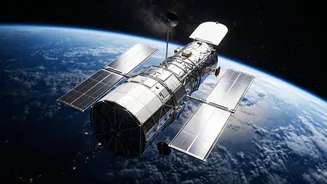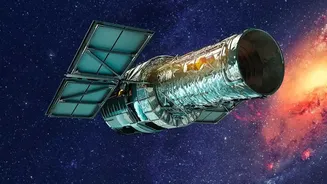






For over three decades, the Hubble Space Telescope has been humanity's tireless eye on the cosmos. Now, its legendary journey is at risk. NASA has put out a call to the private sector, seeking ideas to save an icon.
An Icon Facing a Slow Descent
Since its launch in 1990, the Hubble
Space Telescope has fundamentally changed our understanding of the universe, capturing breathtaking images that have become cultural touchstones. From helping to determine the age of the universe to imaging distant galaxies, its contributions are immeasurable. But after more than 35 years in service, the observatory is showing its age. Two primary issues threaten its future: failing gyroscopes and orbital decay. The gyroscopes are essential for pointing the telescope with precision, and their numbers are dwindling. More critically, Hubble is slowly falling. Constant atmospheric drag is pulling the telescope down from its low-Earth orbit, and without its own propulsion system, it cannot stop this descent. Projections show it could make a fiery, uncontrolled re-entry into the atmosphere sometime in the mid-2030s if no action is taken.
The Call for Commercial Partners
Recognizing the urgency, NASA has taken a modern approach: it has issued a formal Request for Information (RFI). This isn't a contract for a mission but rather a market survey to see what the burgeoning commercial space industry can offer. The RFI outlines three potential scenarios: reboost the telescope to a higher, more stable orbit; service it to upgrade its scientific capabilities; or, as a last resort, guide it to a safe, controlled de-orbit. By inviting ideas from private companies, NASA is acknowledging a new era of space exploration, one where public-private partnerships can tackle complex challenges that were once the sole domain of government agencies. The deadline for submissions is set for the end of November 2026, giving NASA a chance to evaluate the feasibility, cost, and innovation of potential commercial solutions.
Who Could Answer the Call?
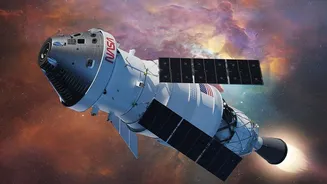
The most prominent name in the conversation is SpaceX. The company, in partnership with the private Polaris Program funded by billionaire Jared Isaacman, had previously entered into an agreement with NASA to study the feasibility of using a Dragon spacecraft to dock with and reboost Hubble. That initial study, conducted at no cost to the government, concluded that such a mission was technically possible, laying the groundwork for this new, broader request for information. The Polaris Program has its own goals of pushing the boundaries of space technology, including conducting commercial spacewalks, which could potentially be leveraged for a servicing mission. However, the RFI is not exclusive to SpaceX. Other companies with experience in satellite servicing and robotics, like Northrop Grumman, could also present viable concepts, either robotic or crewed, to address NASA's request.
What Would a Rescue Mission Look Like?
A reboost mission is the most discussed option. A commercial spacecraft would need to rendezvous with Hubble, dock with it, and then use its own engines to push the combined stack into a higher orbit. Raising it back to its original altitude of around 600 kilometers could add 15 to 20 years to its operational life. Such a maneuver is delicate; Hubble was not originally designed for this type of robotic docking, though a soft capture mechanism was installed during the final Space Shuttle servicing mission in 2009. A more ambitious mission might also include servicing, potentially replacing failing gyroscopes or installing new instruments, similar to the five crewed servicing missions performed by Space Shuttle astronauts. This would likely be a far more complex and costly undertaking, but it represents the ultimate life extension for the venerable observatory.
Why Saving Hubble Still Matters
With the powerful James Webb Space Telescope (JWST) now operational, some may question the need to invest in Hubble. However, the two observatories are complementary, not redundant. JWST is optimized for infrared light, peering deep into the early universe, while Hubble remains the premier observatory for visible and ultraviolet light. It continues to produce worldclass science, from studying weather on planets in our own solar system to observing phenomena that JWST cannot. Losing Hubble would leave a critical gap in astronomers' capabilities. For many, the telescope is also a source of inspiration and a symbol of human curiosity. Its potential rescue represents more than just saving a satellite; it’s about preserving a scientific and cultural icon for a new generation.