






Searching for a no-equipment exercise to challenge your upper body? The dolphin push-up is a powerful movement that builds serious strength in the shoulders, core, and arms, making it a fantastic addition to your home workout routine.
What Is a Dolphin Push-Up?
The dolphin push-up
is a dynamic bodyweight exercise that blends elements of a plank and a pike. It originates from the 'Dolphin Pose' in yoga, but adds a pressing movement that significantly increases the challenge. While the name suggests a standard push-up, it’s actually a vertical pressing motion that primarily targets the shoulders (deltoids). However, your triceps, upper chest, and core muscles are heavily engaged to stabilize and assist throughout the movement, making it a highly efficient compound exercise. It’s a fantastic way to build the foundational strength needed for more advanced movements like handstands, but it stands on its own as a potent upper-body sculptor.
How to Perform It Correctly
Proper form is crucial to maximize benefits and prevent injury, particularly in the shoulders. Follow these steps to execute the dolphin push-up safely:
1. Start in a forearm plank. Place your forearms flat on the floor, shoulder-width apart, with your palms down or clasped. Your body should form a straight line from your head to your heels.
2. Engage your core. Walk your feet in towards your hands, lifting your hips high into the air. Your body will form an inverted 'V' shape. This is your starting position, known as Dolphin Pose.
3. Initiate the push-up. Slowly lower your head and shoulders towards the space just in front of your hands. Keep your elbows tucked in and your core tight to prevent your back from arching.
4. Press back up. Once your head is close to the floor, forcefully press through your forearms and shoulders to return to the starting Dolphin Pose. The power should come from your shoulders and triceps, not from momentum.
Aim for controlled, deliberate repetitions rather than rushing through the set.
Key Benefits of the Movement
Incorporating dolphin pushups into your fitness regimen offers more than just triceps engagement. One of its primary advantages is building powerful and stable shoulders. This increased stability can help protect the shoulder joint, which is prone to injury. Furthermore, the exercise demands constant core activation to prevent your lower back from sagging, leading to a stronger midsection. As a bodyweight exercise, it can be done anywhere without the need for dumbbells or machines, making it perfect for home workouts or travel. It also improves thoracic spine mobility and hamstring flexibility, as holding the inverted 'V' position provides a gentle stretch.
Common Mistakes to Avoid
To get the most out of every rep, watch out for these common form errors:
Flaring the elbows: Letting your elbows splay out to the sides shifts the stress away from your shoulders and triceps and can strain your joints. Keep them tucked in, directly under your shoulders.
Losing core tension: A sagging lower back is a sign that your core is not engaged. This puts undue pressure on your spine and reduces the effectiveness of the exercise. Keep your abs braced throughout.
Rushing the negative: The lowering phase of the movement is just as important as the push. Control your descent to build strength and stability, rather than just dropping into the bottom of the rep.
Looking straight down: Try to look slightly forward, towards your hands. Tucking your chin to your chest can cause you to round your upper back and compromise your form.
How to Modify the Exercise
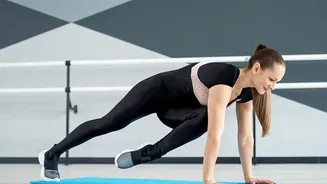
The dolphin pushup is challenging, but it can be adapted for various fitness levels. If you're a beginner, start by simply holding the Dolphin Pose for 30–60 seconds to build isometric strength in your shoulders and core. Another modification is to perform the pushup from your knees, which reduces the amount of body weight you have to lift. As you get stronger, you can progress to the standard version. For an advanced challenge, try lifting one leg off the ground throughout the set. This creates an unstable base, forcing your core and shoulders to work even harder to maintain balance.