




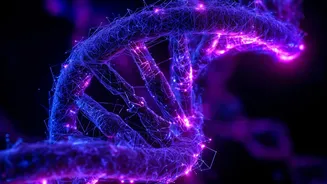
For decades, the root causes of many genetic diseases have been trapped in our DNA, like secrets written in a language we could barely read. Now, a powerful artificial intelligence from Google's DeepMind is beginning to translate that language for us.
First, Cracking the Protein Code
The story begins with a fundamental challenge in biology known as the 'protein folding problem'. Proteins are the microscopic workhorses of our bodies, responsible for nearly every biological process. They start as long chains of amino acids that must fold into precise, complex 3D shapes to function correctly. If they misfold, they can cause devastating diseases, including Alzheimer's, Parkinson's, and cystic fibrosis. For 50 years, determining a single protein's structure could take scientists years of painstaking lab work. In 2020, Google DeepMind's AI model, AlphaFold, changed everything. It can predict a protein's 3D structure from its amino acid sequence in minutes with incredible accuracy, solving a grand challenge of biology. This breakthrough, which was recognized with a Nobel Prize, provided a massive library of over 200 million protein structures to researchers for free, dramatically accelerating the study of everything from antibiotic resistance to cancer.
The Next Clue: Sorting Mutations
While knowing a protein's shape is a giant leap, it's only part of the puzzle. The next question is: what makes a protein go wrong in the first place? Often, the culprit is a tiny change in our DNA called a 'missense mutation'. Think of it as a single typo in the genetic instruction manual. This one-letter change can alter the resulting protein, sometimes harmlessly, but other times catastrophically. The problem is that humans have millions of these variations, and for most, their effect is unknown. They are labelled 'variants of unknown significance', leaving doctors and patients in the dark. This is where AlphaFold's successor, AlphaMissense, comes in. Released in 2023, this AI model was specifically trained to look at a missense mutation and predict whether it is likely to be 'pathogenic' (disease-causing) or 'benign' (harmless).
A 'Weather Forecast' for Our Genes
AlphaMissense analyzed all 71 million possible missense mutations in the human genome. It then assigned each a score from 0 to 1, indicating its likelihood of causing disease. The results were staggering: the AI classified 89% of all possible mutations, predicting 32% as likely pathogenic and 57% as likely benign. For comparison, human experts had only managed to classify about 0.1% of these variants before. It does this not by looking at patient data, but by analyzing the protein's structure, how that part of the protein has been preserved across species through evolution, and other factors. This gives researchers a powerful tool to filter the genetic noise and focus their efforts on the mutations most likely to be driving disease, helping to speed up diagnosis for rare conditions and uncover new disease-causing genes.
From Theory to Tangible Progress
These AI tools are already having a real-world impact. Scientists are using AlphaFold and AlphaMissense to better understand the machinery behind diseases and accelerate the search for treatments. For example, researchers have used the technology to model a protein linked to Parkinson's disease, revealing how the body's own immune system can disrupt it and opening new avenues for earlier diagnosis. Others are applying it to combat antibiotic resistance by studying the structures of bacterial proteins. In Malaysia, one team is using it to fight Melioidosis, a deadly disease, by understanding how its proteins work. And in cancer research, the models help map out how genetic disruptions can lead to disease, which one professor described as being like 'the internet for structural biology'. By providing these 'early insights,' the AI allows scientists to form better hypotheses and design more effective experiments, saving invaluable time and resources.