


The Case of the Vanishing Planet
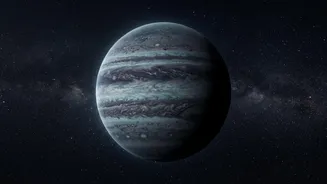
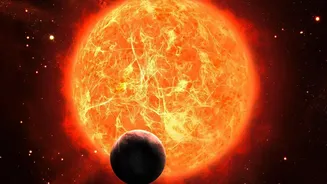
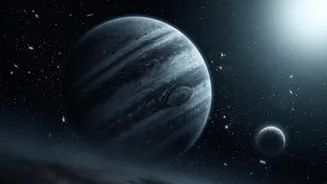
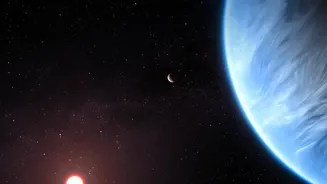
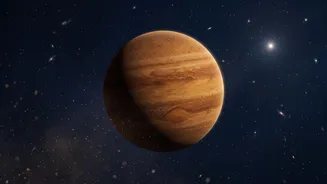
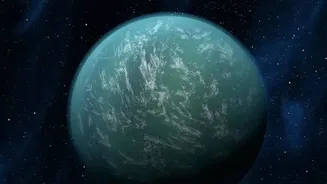
Imagine watching a star 1,000 light-years away, patiently waiting for a giant planet to pass in front of it, causing a slight dip in starlight. For seven years, astronomers using NASA's TESS space telescope did just that with TOI-2535 b, a 'hot Jupiter'
exoplanet. These giant gas worlds orbit their stars at blistering speeds; TOI-2535 b completes a full year in just 8.25 Earth days. But then, in March 2026, the expected dip in starlight never came. The planet, from our perspective, had vanished. It wasn't a one-time fluke. The planet had simply stopped transiting its star.
A Trail of Cosmic Breadcrumbs
A planet doesn’t just disappear. The scientists, led by a team at UCLA, knew there had to be an explanation. The clues lay in the years of data leading up to the vanishing act. They noticed that the planet’s transits weren't happening on a clockwork schedule. Sometimes, TOI-2535 b would arrive up to six hours early for its stellar crossing; other times, it would be six hours late. Furthermore, over the seven years of observation, the transits themselves were changing. They became shorter in duration and shallower, meaning the planet was blocking less and less of its star's light with each pass. These irregularities were tell-tale signs that something else was gravitationally meddling with the planet's orbit.
The Hidden Player Revealed
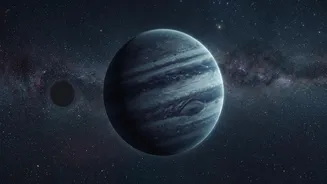
The culprit, astronomers concluded, was another, unseen planet in the same system. This hidden companion is also a gas giant, likely at least the mass of Saturn, and its own orbit is tilted relative to TOI-2535 b's. The mutual gravitational pull between these two massive worlds is causing both of their orbits to wobble, much like spinning tops. As Samuel Yee, a UCLA astronomer and co-author of the study, explained, the universe is not always as regular as a clock. This constant gravitational tug-of-war slowly changed the tilt of TOI-2535 b's orbit until it no longer passed between its star and Earth. From our vantage point, it disappeared.
An Eclipse Analogy
This cosmic alignment game is similar to why we don't have a solar eclipse every month on Earth. The Moon's orbit around Earth is slightly tilted compared to Earth's orbit around the Sun. An eclipse only happens during those rare moments when all three bodies line up perfectly. For TOI-2535 b, its orbit has now tilted out of that perfect alignment, and its transits have ceased. This is the most extreme example of planet-planet interaction causing such a rapid orbital change ever witnessed by astronomers. The precession, or wobble, is so fast that its period is measured in decades, not centuries as seen in other systems.
Clues to Planetary Formation
This peculiar system also offers new insights into how 'hot Jupiters' form. These planets are so close to their stars that scientists have long debated how they got there. One theory suggests a violent past, where gravitational chaos 'flings' a planet into a close-in orbit. Another suggests a slower, more gentle migration inward through the early protoplanetary disk. The presence of a close giant companion like the one influencing TOI-2535 b makes the slow migration theory more likely for this system. However, that slow journey should have resulted in a flat system, without tilted orbits. The wobble suggests the system experienced other interactions over time that twisted the orbits.