





The Unsung Heroes of Re-entry
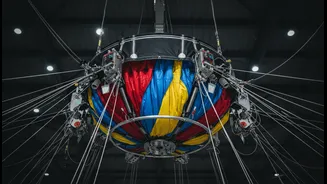
While rockets and crew capsules grab the headlines, the success of human spaceflight often comes down to a technology that is thousands of years old: textiles. But these are no ordinary fabrics. 'Deployable textiles' is the term for the highly engineered,
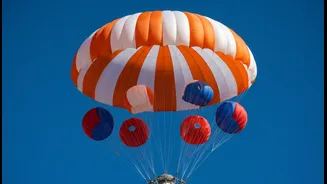
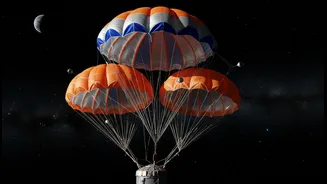
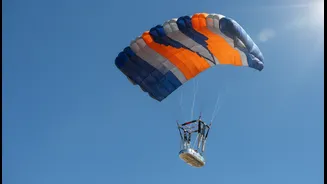
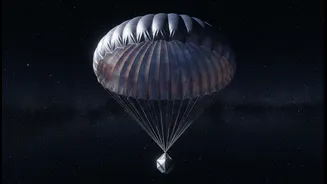
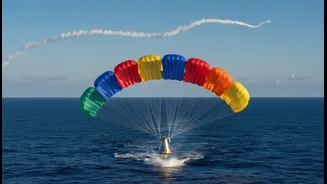
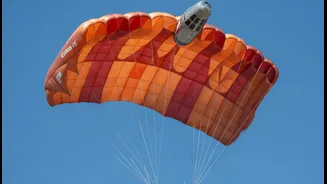
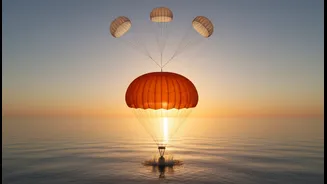
multi-layered systems that ensure a spacecraft, and its precious human cargo, can slow from hypersonic speeds to a gentle landing. For India's ambitious Gaganyaan mission, this means a sophisticated parachute system. This isn’t a single chute, but a sequence of ten parachutes of four different types that deploy in a precise cascade. It starts with parachutes to separate the module's protective cover, followed by drogue parachutes to stabilise the capsule at high speeds, and finally, three massive main parachutes to bring it to a safe splashdown velocity.
Fabric Engineered for Extremes
Creating these textiles is a monumental engineering challenge. The materials must be incredibly strong yet lightweight, and capable of withstanding unbelievable forces. As the crew module re-enters the atmosphere, the parachutes are deployed at supersonic speeds, creating immense strain. The fabrics must resist tearing under loads equivalent to several tons. The process is so violent that the parachutes are deployed in stages, using a technique called 'reefing', where they are first opened partially to reduce the initial shock before being fully unfurled. This complex sequence, using pyro-based devices to cut the reefing lines, is a key innovation tested by the Indian Space Research Organisation (ISRO). These textiles are not just simple nylon; they are often advanced composites and high-strength synthetic fibres designed for extreme heat and stress.
India's Meticulous Path to Perfection
ISRO, in collaboration with the Defence Research and Development Organisation (DRDO), is leaving no stone unturned in perfecting this system. The Vikram Sarabhai Space Centre (VSSC) has been leading a series of rigorous trials, known as Integrated Main Parachute Airdrop Tests (IMAT). In these tests, a mass equivalent to the Gaganyaan crew module is dropped from an Indian Air Force IL-76 aircraft from a high altitude to simulate the re-entry sequence. Recent tests in 2026 have focused on qualifying the system under the most critical load conditions, ensuring every component works flawlessly. These tests are not just about success; they also simulate failure scenarios, such as one of the three main parachutes failing to open, to prove that the system is redundant and can safely land the crew even with two chutes.
More Than Just Parachutes
Beyond the deceleration parachutes, deployable textiles also include the inflatable flotation systems that are crucial after the capsule has splashed down in the ocean. These systems, which deploy automatically, ensure the crew module remains upright and afloat, allowing recovery teams to safely reach the astronauts. The development of these technologies is a hallmark of indigenous innovation, involving a close partnership between ISRO centres like VSSC, DRDO labs such as the Aerial Delivery Research and Development Establishment (ADRDE), and the Indian Armed Forces for logistical support. This national collaboration highlights the importance of mastering this 'soft' technology for the 'hard' challenge of space exploration.
The Final Guarantee for Gaganyaan
Ultimately, these sophisticated textiles are all about one thing: human safety. For the Gaganyaan mission, which aims to send Indian astronauts into orbit, the reliability of the parachute system is non-negotiable. It is the final and most critical phase of the mission, responsible for bringing the crew home safely after their journey in space. The exhaustive testing campaign, from rail sled tests of individual components to full-scale airdrop tests, demonstrates ISRO's commitment to ensuring the system is as close to perfect as humanly possible. Each successful splashdown test builds confidence not just in the technology, but in India's capability to join the elite club of nations that have mastered human spaceflight.