





Beyond Radio Signals
For decades, the search for extraterrestrial intelligence (SETI) was synonymous with listening. Scientists scanned the skies with radio telescopes, hoping to eavesdrop on a message deliberately sent our way. But this new chapter in the search is less
about waiting for a call and more about active investigation. Scientists are expanding their toolkit to hunt for 'technosignatures'—any measurable evidence of technology. This could be anything from the atmospheric pollution of an industrial civilization to the heat signature of massive artificial structures. The idea is simple: what if advanced life isn't broadcasting, but its technology still leaves a detectable trace? This transforms the search from a passive waiting game into a proactive forensic investigation of entire planets.
A World of Possibility
Enter K2-18b, a planet 124 light-years away that has become a tantalizing target for astronomers. It is a 'sub-Neptune,' more than eight times the mass of Earth, and orbits its star within the habitable zone, where liquid water could exist. Observations from the James Webb Space Telescope (JWST) have made K2-18b even more intriguing. They revealed carbon-bearing molecules like methane and carbon dioxide in its atmosphere, consistent with a 'Hycean' world—a hypothetical planet with a global water ocean under a hydrogen-rich atmosphere. There was even a tentative detection of dimethyl sulfide (DMS), a gas that on Earth is predominantly produced by marine life like phytoplankton. While this potential 'biosignature' is heavily debated, it has made K2-18b a prime candidate for a closer look.
Hunting for an Alien Footprint
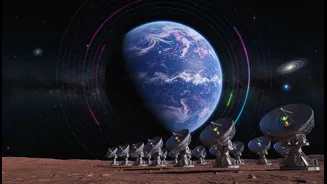
Instead of just looking for signs of life, a recent project turned its attention to searching for signs of technology on K2-18b. Rather than listening for radio messages, researchers used powerful radio telescopes like the Very Large Array and MeerKAT to conduct one of the most sensitive technosignature searches ever. Their goal was to see if they could detect narrowband radio signals that might indicate the presence of technology. Using advanced software, they sifted through millions of potential signals, filtering out interference from Earth-based sources and other cosmic noise.
The Significance of Silence
The search came up empty; no convincing technosignatures were found. But in science, a null result is not a failure. The project was a resounding success in another, more important way: it proved the method works. Scientists demonstrated a powerful new approach to filtering massive datasets to hunt for faint, artificial signals from a distant world. By finding nothing, they were able to set an 'upper limit' on the technology that might exist there, concluding that if a civilization is present, it is not broadcasting with anything more powerful than Earth's strongest radar transmitters. This provides a crucial baseline for all future searches.
A New Toolkit for the Hunt
The K2-18b search represents a significant evolution in the quest for extraterrestrial intelligence. The focus is broadening from biosignatures (signs of life) to include technosignatures (signs of technology), and the tools are becoming exponentially more powerful. With instruments like the JWST, scientists can now analyze the chemical makeup of exoplanet atmospheres in unprecedented detail, looking for industrial pollutants that have no natural explanation. At the same time, advances in artificial intelligence and data processing allow astronomers to conduct deeper, more sophisticated searches for technological signals across the electromagnetic spectrum. We are moving beyond simply asking 'are we alone?' and are beginning to develop the methods to answer the question, 'how would we know if we weren't?'