


The solar system feels like the definition of stability. But what if it isn't? New computer simulations exploring the far future have uncovered a startling possibility: in some scenarios, the mighty ringed planet Saturn gets kicked out entirely.
A Cosmic Upset
Our solar
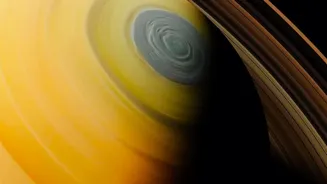
system has been a reliable cosmic neighbourhood for billions of years. The planets follow their paths, held in a delicate gravitational dance. However, a new set of powerful computer simulations suggests this stability might not last forever. Researchers running hundreds of different models of the solar system's distant future found that in a number of scenarios, the entire system descends into chaos. Most dramatically, some of these simulations ended with Saturn, the second-largest planet, being completely ejected into interstellar space. This outcome stems from new research into how the Sun will behave as it dies. In about five billion years, the Sun will run out of hydrogen, swell into a red giant, and eventually collapse into a white dwarf, losing about half its mass in the process. Previous models assumed this mass loss would be smooth. The new study, however, considers a more violent, uneven process, where the Sun spits out mass in thousands of separate, random bursts. It is these uneven 'kicks' that could eventually nudge the giant planets into unstable orbits.
The N-Body Problem
Predicting the motion of planets is one of the oldest challenges in science. When there are only two bodies—like the Sun and a single planet—the maths is straightforward and the orbit is perfectly predictable. This is the 'two-body problem'. But add a third body, and the gravitational interactions become incredibly complex and chaotic. This is the famous 'n-body problem', which has no general solution. Our solar system is an n-body problem with many players. Every planet, moon, and asteroid is constantly pulling on every other object. For the most part, these tugs are tiny and average out, leading to the stable system we see today. However, over immense timescales—billions of years—even minuscule perturbations can grow exponentially. This is the essence of chaos theory, where a tiny change in initial conditions can lead to wildly different outcomes down the line. The new simulations show how the Sun's sputtering mass loss could provide just enough of a nudge to send the outer planets' delicate dance into disarray.
The Role of Resonance
A key factor in this potential instability is 'orbital resonance'. This happens when the orbits of two bodies are related by a simple ratio of whole numbers. For example, Jupiter and Saturn have a near 5:2 resonance, meaning Jupiter completes about five orbits for every two of Saturn's. These resonances can be stabilizing, locking planets into predictable patterns. However, they can also be a source of chaos. The simulations suggest that as the Sun's gravitational grip weakens, the giant planets' orbits will expand. This shifting architecture could push Jupiter and Saturn into a more disruptive resonance, amplifying their gravitational pushes and pulls on each other and on their neighbours, Uranus and Neptune. In about 40% of the simulated systems that modelled this uneven mass loss, this led to major disruptions, including Uranus and Neptune swapping orbits or, in the most extreme cases, Saturn getting the boot.
A Solar System Without Saturn
What would a solar system without Saturn even look like? The immediate effect on Earth would be negligible. The planets are so far apart that Saturn's sudden absence wouldn't be felt gravitationally here in any meaningful way. The longterm consequences, however, are more significant. Saturn acts as a crucial gravitational counterbalance to the immense pull of Jupiter. Together, they sculpt the orbits of asteroids and comets, and their combined influence helps maintain the stable architecture of the entire system. Without Saturn, Jupiter's influence would become more dominant and less controlled. Over millions of years, this could destabilize the asteroid belt, potentially sending more objects on paths that could intersect with Earth. The loss of Saturn would fundamentally change the longterm dynamics of our cosmic home, making it a less predictable and potentially more hazardous place. The planet's many moons, including the massive Titan, would become untethered, drifting through the solar system as new sources of chaos.