





The Sun’s Turbulent Weather
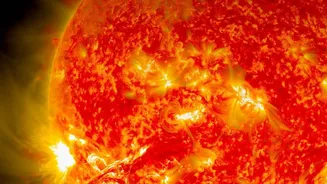
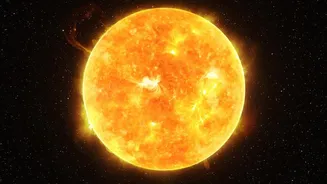
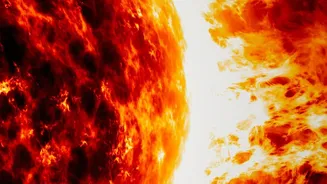
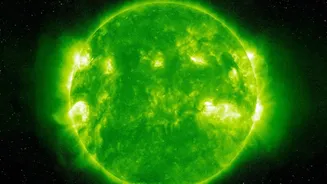
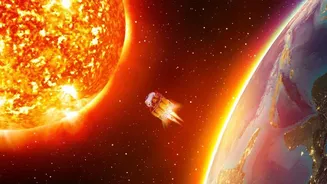
A solar storm is a major disturbance on the sun that can send massive bursts of energy and plasma into space. These events often originate from solar flares or coronal mass ejections (CMEs). A CME is essentially a giant cloud of solar plasma and magnetic
fields that gets ejected from the sun. If Earth is in the path of one of these ejections, the charged particles can travel millions of kilometres and reach our planet in as little as 18 hours, though it can take several days. While Earth's magnetic field—our magnetosphere—protects us from the worst of this solar wind, a particularly strong storm can overwhelm these natural defences, triggering what is known as a geomagnetic storm. These storms don't harm humans on the ground, but they can wreak havoc on the technological systems we depend on daily.
A Wired World at Risk
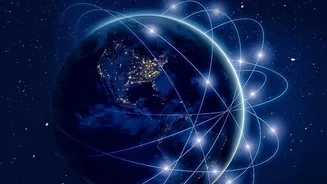
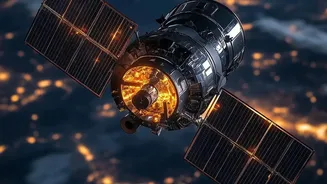
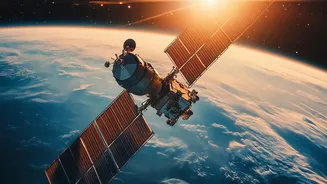
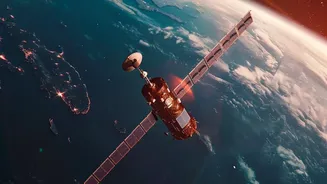
Our increasing reliance on technology makes us more vulnerable to the effects of space weather. Satellites are particularly at risk. They operate outside the full protection of Earth's atmosphere and can be damaged by high-energy particles. This can lead to electronic failures, degraded solar panels, and system errors. Strong solar storms can also heat the upper atmosphere, causing it to expand. This increases atmospheric drag on satellites in low-Earth orbit, which can alter their trajectory or even cause them to fall out of orbit. On the ground, the primary threat is to our power grids. Geomagnetic storms can induce powerful currents in long conductors like transmission lines and pipelines. These geomagnetically induced currents (GICs) can overload transformers, leading to widespread blackouts and potentially causing permanent damage that is expensive and time-consuming to repair. Furthermore, the accuracy of GPS and other global navigation satellite systems (GNSS) can be degraded, affecting aviation, shipping, and agriculture.
The Cosmic Weathermen
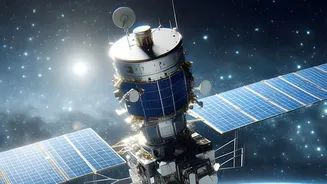
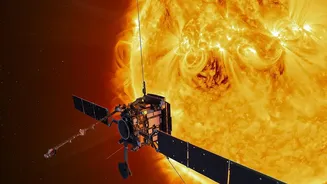
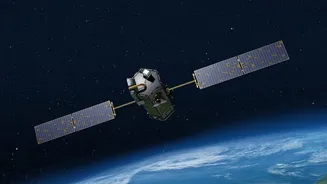
This is where solar storm alerts become our vital first line of defence. Specialised agencies, like the U.S. National Oceanic and Atmospheric Administration's (NOAA) Space Weather Prediction Center (SWPC), act as the world's cosmic weathermen. They use a network of ground-based and space-based observatories to constantly monitor the sun. Satellites like the Deep Space Climate Observatory (DSCOVR), positioned strategically between the Sun and Earth, measure the solar wind in real time. This allows forecasters to see a CME coming and predict its speed, trajectory, and potential intensity. By analysing this data, they can issue watches, warnings, and alerts with lead times ranging from minutes to days, depending on the type of event.
From Warning to Action
An advance warning, even of just a few hours, is invaluable. It allows operators of critical infrastructure to take protective measures. Satellite operators can put their spacecraft into a safe mode, orienting them to protect sensitive components or temporarily shutting down non-essential systems to prevent electrical damage. Power grid managers can take steps to protect their networks. These actions might include discontinuing non-critical maintenance, reducing the load on vulnerable high-voltage lines, and bringing standby generators online to ensure grid stability. In some cases, specialised equipment like neutral blocking devices can be used to stop damaging GICs from entering transformers. For airlines, warnings about solar radiation storms allow them to reroute flights that would normally pass over polar regions, protecting crew, passengers, and communication systems from increased radiation exposure.
Strengthening Our Shields
As our world becomes even more interconnected and dependent on technology, the importance of robust space weather forecasting will only grow. Researchers are constantly working to improve prediction models to increase warning times and forecast accuracy. Projects like NASA's Solar Shield are developing forecasting systems specifically to help power grid operators mitigate the effects of GICs. By understanding the threat posed by the sun and investing in the systems that monitor it, we can ensure that a bout of bad space weather doesn't bring our digital world to a standstill. These alert systems are a quiet, crucial shield, protecting the intricate web of technology that supports modern civilization.