



The Unseen Connection
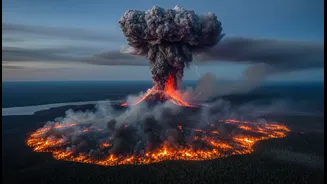
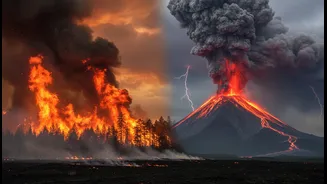
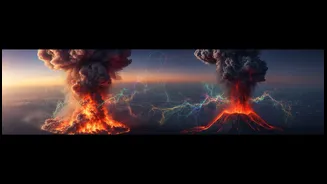
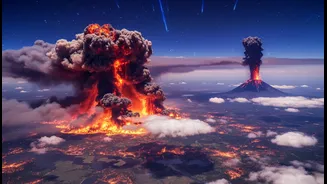
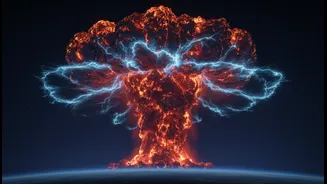
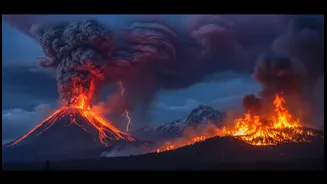
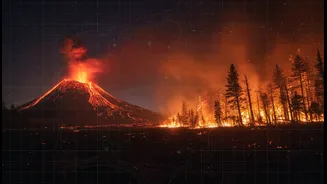
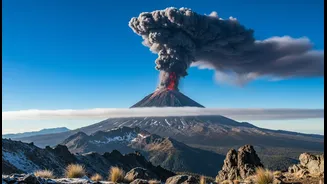
Deep below us and far above us, a powerful connection exists. Events on the Earth's surface—like a raging wildfire or a colossal volcanic eruption—can have profound and disruptive effects on the highest reaches of our atmosphere. These are not just ground-level
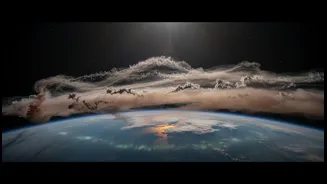
disasters; they are events that send shockwaves vertically, reaching layers like the stratosphere, thermosphere, and ionosphere. This region, hundreds of kilometers up, is often called 'space weather', and it's where our critical satellite infrastructure operates. For years, scientists primarily focused on the Sun's activity as the main driver of space weather. But a growing body of research shows that we have to look down to truly understand what’s happening up.
Ripples in the Air
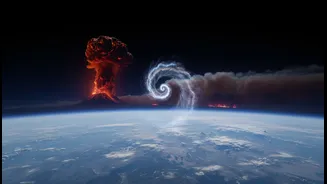
So, how does a fire on the ground affect something 100 kilometers high? The answer lies in atmospheric gravity waves (AGWs). Think of the atmosphere as a vast ocean of air. When a powerful event occurs on the surface, it creates a massive disturbance, like dropping a giant stone into a pond. The intense heat from a megafire or the explosive force of a volcano pushes a huge column of air upwards. This displacement generates waves of energy that travel vertically through the atmospheric layers. These are not like ocean waves you can see, but ripples in air pressure and density that can journey for hundreds of kilometers with minimal energy loss. As they reach the thinner air of the upper atmosphere, their impact becomes magnified, creating significant disruptions.
A Cocktail of Disruptive Particles
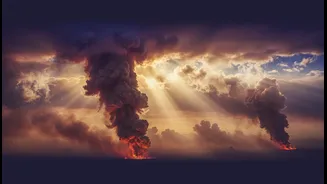
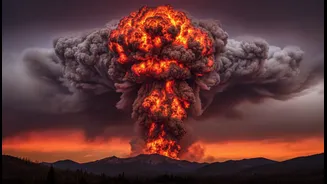
Beyond just creating waves, these events also act like giant chimneys, spewing tonnes of material high into the sky. Volcanoes inject massive amounts of sulfur dioxide and ash into the stratosphere. The sulfur dioxide converts into sulfate aerosols that act like tiny mirrors, reflecting sunlight and altering temperatures. Intense wildfires, through a phenomenon called pyrocumulonimbus clouds (fire-fueled thunderstorms), can blast smoke, ash, and water vapour into the stratosphere. These dark smoke particles are particularly effective at absorbing solar radiation, causing significant warming in the stratosphere, an effect observed after the massive Australian wildfires of 2019-2020. These materials don't just stay local; they can persist for months or even years, circling the globe and fundamentally changing the chemistry and temperature of the upper atmosphere.
The Modeling Blind Spot
This is where our predictive models run into trouble. The models used to forecast space weather and calculate satellite orbits rely heavily on data about solar and geomagnetic activity. They are built on decades of observation of how the upper atmosphere behaves under 'normal' conditions. However, major volcanic eruptions and megafires are sporadic, unpredictable, and highly variable. Each event is unique in its chemical makeup and the altitude its plume reaches. Our current models struggle to account for these sudden, massive injections of energy and particles from below. An atmospheric model might predict a satellite's position with an error of a few hundred metres, but during a major disturbance, that error can balloon to several kilometers, a critical failure for collision avoidance and navigation.
Why This Matters for India
The reliability of these atmospheric models isn't just an academic problem. In India, we rely on satellite technology for countless daily functions. The GPS on our phones, the navigation systems for aviation and shipping, and the precise timing required for financial networks all depend on predictable signals from space. Disturbances in the ionosphere, often called Traveling Ionospheric Disturbances (TIDs) and triggered by atmospheric waves, can delay, bend, or degrade these radio signals. Furthermore, changes in atmospheric density—affected by these events—alter the drag on satellites in low-Earth orbit. This can change a satellite's trajectory, making collision avoidance more difficult and shortening its operational lifespan. As we become more dependent on this space-based infrastructure, understanding these terrestrial threats becomes a matter of national importance.