



The Unforgiving Vacuum
The most immediate threat in space is the lack of air pressure. Here on Earth, the atmosphere pushes down on our bodies at 14.7 pounds per square inch, a constant pressure we don't even notice. In the vacuum of space, that external pressure vanishes.
Without protection, an astronaut would lose consciousness in about 15 seconds as oxygen leaves the blood and lungs. The fluids in their body would begin to vaporize in a process called ebullism, causing massive swelling, though the skin would prevent the body from literally exploding. Death would follow in a couple of minutes.
A World of Extreme Temperatures
Space is a place of wild temperature swings. Without an atmosphere to distribute heat, an astronaut in direct sunlight can face temperatures soaring to 121°C (250°F). Just a few moments later, when passing into shadow, the temperature can plummet to a bone-chilling -157°C (-250°F). This is a temperature range of almost 300°C, far beyond anything a human body could withstand. Survival depends entirely on insulation from these extremes.
Invisible Dangers: Radiation and Debris
Earth's magnetic field and atmosphere shield us from the constant bombardment of harmful space radiation. Outside this protective bubble, astronauts are exposed to high-energy cosmic rays and solar radiation that can damage DNA and increase long-term health risks like cancer and cardiovascular disease. Another threat comes from micrometeoroids and orbital debris. These tiny particles, often no bigger than a grain of sand, travel at speeds of up to 27,000 kilometers per hour. At that velocity, even a minuscule fleck can cause catastrophic damage.
The Suit: A Personal Spaceship
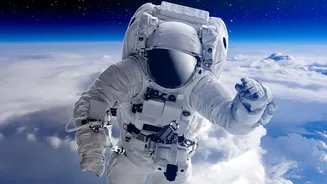
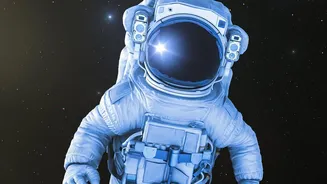
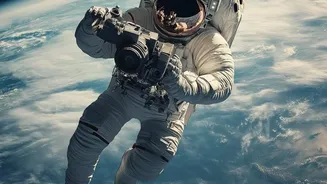
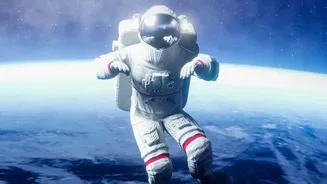
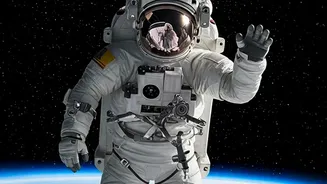
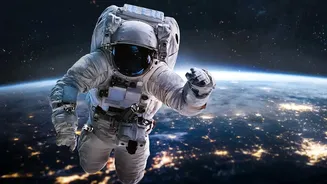
To counter these lethal threats, a spacesuit is not just a set of clothes; it is a human-shaped spacecraft. Formally known as an Extravehicular Mobility Unit (EMU), its primary job is to create a livable bubble around the astronaut. This is achieved through a complex system of layers and a life-support backpack that work in concert to provide everything a human needs to survive in the void.
Pressure, Oxygen, and a Clear Head
The core of the spacesuit is a bladder and restraint system. An inner, rubbery layer, much like a balloon, is filled with pure oxygen to a pressure of about 4.3 psi. This is enough to keep body fluids stable and provide breathable air. A tough outer restraint layer prevents the bladder from ballooning into a rigid, immovable shape. The backpack, known as the Primary Life Support System (PLSS), provides this oxygen and contains a system to remove the carbon dioxide the astronaut exhales, preventing a toxic buildup.
Staying Cool (and Warm)
To manage the extreme temperatures, astronauts first put on a Liquid Cooling and Ventilation Garment. This spandex-like undergarment is woven with thin plastic tubes that circulate cool water, drawing away body heat. The suit itself is then heavily insulated with a Thermal Micrometeoroid Garment, which consists of many layers. These include multiple layers of aluminized Mylar, which function like a high-tech thermos, reflecting heat. The outermost layer is typically white to reflect the intense heat of the sun.
An Armor of Fabric
The outer layers of the suit are designed for toughness. A blend of materials like Kevlar, Gore-Tex, and Nomex provides protection against tiny, high-speed micrometeoroid impacts and tearing. These layers can slow down and break up debris before it can puncture the critical pressure bladder inside. The helmet's visor has its own special protection: a thin coating of gold that reflects harmful ultraviolet and infrared radiation, acting as a super-powered pair of sunglasses.