

The Standard Cosmic Story
For decades, scientists have operated with a standard model of cosmology, known as the Lambda-CDM model. It's a grand narrative that starts with the Big Bang about 13.8 billion years ago. In this story, the universe began as a hot, dense soup. As it expanded
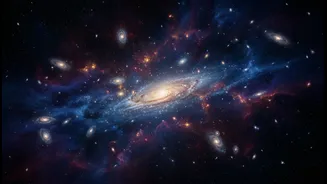
and cooled, gravity began its slow, patient work. Invisible scaffolds of 'cold dark matter' (the CDM part) formed halos, which gradually pulled in gas. Over hundreds of millions, or even billions, of years, this gas slowly clumped together, ignited into stars, and eventually formed the first small galaxies. These then merged over cosmic eons to create the larger, grander galaxies like our own Milky Way. The key word here is 'gradual'. Galaxy formation was thought to be a slow-and-steady process.
A New Eye on Cosmic Dawn
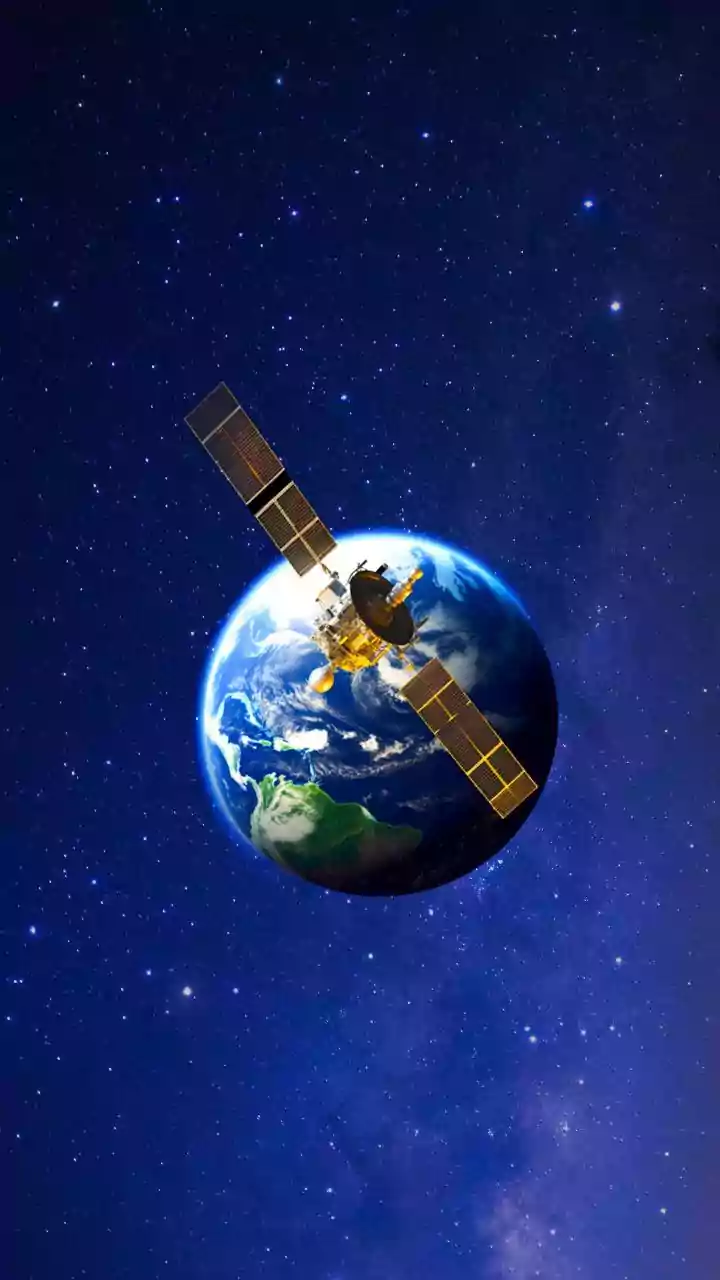
Enter the James Webb Space Telescope (JWST). Launched as the successor to the Hubble Space Telescope, its powerful mirrors and sensitivity to infrared light allow it to peer further back in time than ever before. Because light from distant objects takes billions of years to reach us, seeing these far-flung galaxies is like looking at the universe in its infancy—an era known as the 'cosmic dawn'. Astronomers expected JWST to confirm the standard model, perhaps spotting the faint, wispy proto-galaxies that were the predicted building blocks. Instead, it found something that, at first, seemed impossible.
Finding Giants in the Nursery
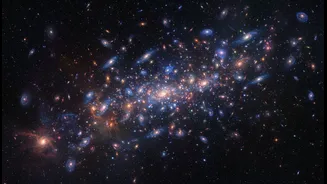
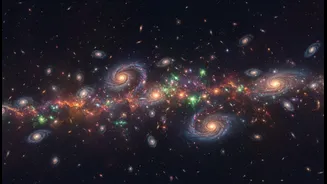
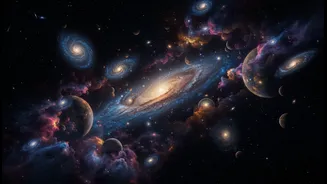
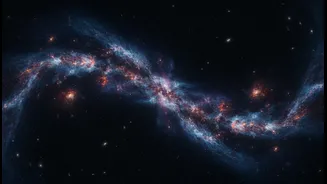
In the earliest datasets from JWST, astronomers found not just faint, young galaxies, but galactic behemoths. They discovered galaxies that appeared stunningly massive and mature just 500-700 million years after the Big Bang—a mere fraction of the universe's current age. Finding a galaxy as massive as the Milky Way this early is the cosmic equivalent of finding a fully grown adult in a newborn nursery. These 'impossible early galaxies' were not just big; they were surprisingly bright and complex, some appearing to be far more efficient at turning gas into stars than models predicted. In some cases, the number of bright, early galaxies exceeded predictions by a factor of one hundred.
Why This Breaks the Rules
This discovery presents a major conundrum for the Lambda-CDM model. According to the established timeline, there simply wasn't enough time for these galaxies to form. The model dictates that dark matter halos needed more time to gather enough gas to fuel such rapid and massive star formation. As one scientist put it, the findings upend what was thought to be settled science, creating "problems for science" because it calls the entire picture of early galaxy formation into question. It’s not just their mass; it’s their maturity. Some recent discoveries include a massive early galaxy that shows no sign of rotation, a trait normally seen only in much older galaxies that have undergone billions of years of mergers.
Rewriting the Beginning
This doesn't mean the Big Bang is wrong, but it does suggest our understanding of the early chapters is incomplete. Scientists are now scrambling to figure out what's missing. Were the 'seeds' of galaxies planted differently? Perhaps primordial black holes provided a gravitational head start. Maybe the process of converting gas into stars was dramatically more efficient in the early universe than it is today. Some researchers are even exploring whether the fundamental properties of the universe, described in the standard model, need to be tweaked. While some initial claims of 'universe-breaking' discoveries have been tempered by further analysis, the tension remains palpable. These galaxies are real, and they demand an explanation.
The Thrill of the Unknown
While a challenge to a long-held theory can seem like a crisis, in science it's an opportunity. The JWST isn't breaking cosmology; it's pushing it forward. The telescope is providing real data on what were once purely theoretical epochs. Researchers now have a flood of new, puzzling observations to work with, from galaxies that are surprisingly messy and chaotic to others that are mysteriously still. This is the scientific process in action: new evidence challenges old ideas, forcing a re-evaluation that ultimately leads to a deeper and more accurate understanding of our cosmic origins. The story of the universe didn't end; we just turned the page to a chapter we never knew existed.