


More Than Just an Icy Spectacle
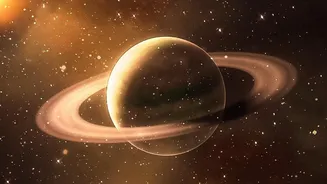
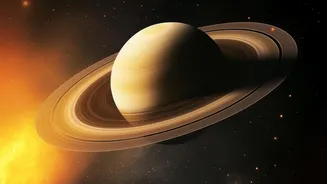
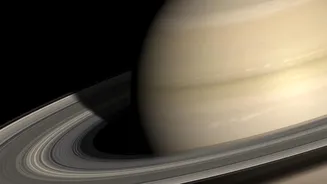
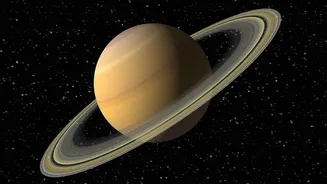
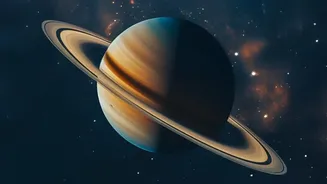
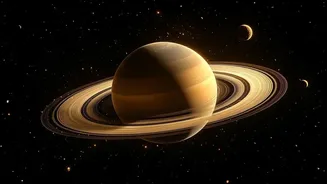
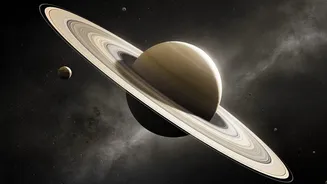
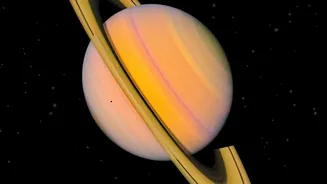
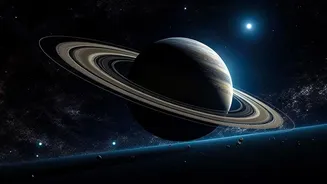
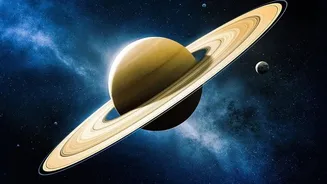
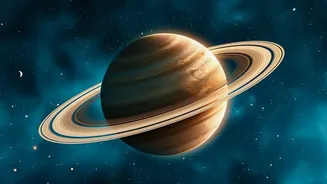
For centuries, we’ve marvelled at Saturn’s rings, a vast, shimmering system that makes the planet instantly recognisable. From a distance, they appear as solid, cohesive bands. Up close, however, they are a swirling collection of countless individual
particles, ranging from the size of a dust grain to that of a large house. The dominant component, making up more than 95% of the rings, is water ice. This is what gives them their brilliant, reflective quality. But if the rings were only made of pristine ice, their story would be quite simple. The real intrigue lies in what makes up the other few percent. Data from NASA’s Cassini spacecraft, which studied the Saturn system for 13 years, revealed that the rings are contaminated with other materials. This non-icy component is what scientists call 'pollution,' and it's the key to unlocking a much bigger narrative.
Cosmic Dust as a Detective
The 'pollution' in Saturn's rings consists of rocky material and dust, likely from micrometeoroids that have been crashing into the ring particles for millions of years. Think of the rings as a vast, clean carpet laid out in space. Over time, this carpet naturally collects dust. By measuring the amount of this cosmic dust, scientists can work backwards to figure out how long the carpet has been there. The Cassini mission was equipped with a Cosmic Dust Analyzer, which did exactly this. It painstakingly collected and analysed the tiny grains of material flowing through the Saturnian system. The findings were startling: the rings were surprisingly clean. They hadn't accumulated the amount of dust that would be expected if they had been around since the formation of Saturn itself, some 4.5 billion years ago. This relative purity suggests that the rings are not primordial relics but a much more recent cosmic addition.
A Surprisingly Young Age
The analysis of this cosmic dust led to a groundbreaking conclusion: Saturn's rings are likely no more than 100 to 400 million years old. This means they may have formed around the time dinosaurs still roamed the Earth, a mere blink of an eye in astronomical terms. This theory challenges the long-held assumption that the rings were born with Saturn. The leading hypothesis now is that the rings are the shattered remains of an icy moon that strayed too close to the planet and was torn apart by its immense gravity, or perhaps the result of a collision between two moons. While there is some ongoing scientific debate, with a few studies suggesting mechanisms that could keep the rings looking clean for longer, the weight of evidence from the Cassini mission points toward this younger age. We are, in essence, witnessing a relatively recent and dramatic event in the life of our solar system.
The Beginning of the End
Not only are the rings young, but they are also temporary. The same mission that helped determine their age also confirmed their impending doom. Scientists discovered a phenomenon known as 'ring rain,' where particles from the rings are being pulled inward by Saturn's gravity and magnetic field. This isn't a gentle shower; it's a constant downpour. It is estimated that an amount of water equivalent to an Olympic-sized swimming pool drains from the rings onto the planet every half an hour. This material, which includes not just water ice but also complex organic molecules, heats and changes the composition of Saturn's upper atmosphere. At this rate, the entirety of Saturn's magnificent rings will be gone in a few hundred million years. In a cosmic sense, we are incredibly fortunate to live in an era where we can witness their splendour.