
A Tiny New World Emerges
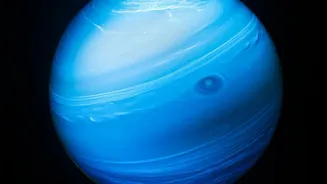
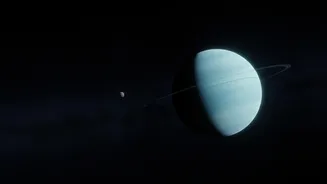
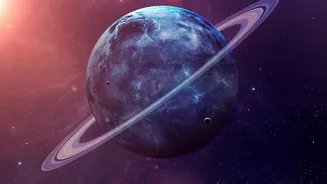
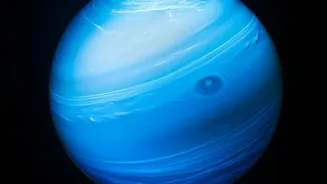
Astronomers have confirmed the existence of the 28th moon orbiting Uranus, a significant discovery announced in early 2024. Provisionally named S/2023 U1, this is the first new satellite found around the ice giant in more than 20 years. First spotted
in November 2023 using the powerful Magellan telescopes in Chile, the moon is incredibly small, measuring just eight kilometres in diameter, making it likely the faintest and smallest of Uranus's known companions. Its orbit is vast, taking 680 days to circle its parent planet. The discovery itself was a technical feat, requiring special image processing techniques to pick out such a faint object against the glare of Uranus and the backdrop of distant stars. Eventually, it will be named after a character from a Shakespeare play, following the tradition for all of Uranus's moons.
Unlocking Clues from a Cosmic Dance
So, how can such a tiny rock, billions of kilometres away, reveal anything new about a giant planet? The answer lies in its orbit. S/2023 U1 doesn't travel alone; its path through space is remarkably similar to two other Uranian moons, Caliban and Stephano. This isn't a coincidence. Astronomers believe these three moons are part of a 'dynamical orbital grouping,' a family of objects that move together. This shared trajectory is strong evidence that they are all fragments of a much larger parent moon that was shattered long ago, most likely by a collision with a rogue comet or asteroid. By finding and tracking this new, smaller piece of the puzzle, scientists can confirm these theories and build a more detailed picture of the catastrophic events that shaped the Uranian system we see today.
A Gravitational Test Particle
Think of the new moon as a sensitive probe floating in Uranus's gravitational field. Because it is so small and distant, its orbit is easily influenced by the subtle gravitational tugs of the planet's larger moons and even the Sun. By precisely tracking its long journey, scientists can refine their models of the entire system's gravitational environment. Each moon, no matter its size, contributes to a complex cosmic dance. The discovery of S/2023 U1 adds a new dancer, whose movements help reveal the forces acting upon everyone on the floor. This allows for a better understanding of the stability of the moon system and provides a clearer window into its evolutionary history.
A Universal Story of Formation
Perhaps the most profound insight offered by this discovery is how it reinforces a universal pattern across our solar system's giant planets. Scientists have long known about similar orbital families of moons around Jupiter and Saturn. Finding another such grouping around Uranus suggests that this process—the capture of large objects that later shatter to form moon families—is a common feature of how giant planet systems evolve. This holds true even for Uranus, which is a planetary oddball tilted on its side by nearly 98 degrees. The discovery shows that despite its unique orientation, Uranus built its moon system in a way that is surprisingly similar to its gas giant neighbours, providing a crucial data point for theories on planet formation across the galaxy.