




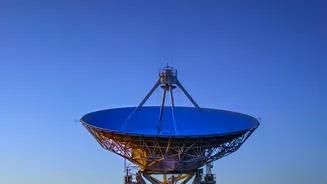
A Telescope on a Continental Scale
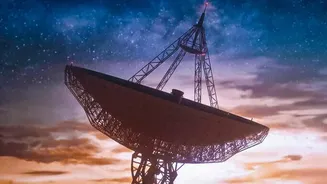
Imagine a telescope so vast it spans two continents. That is the reality of the Square Kilometre Array (SKA). It is not a single instrument but two separate, powerful arrays working in unison. The first, SKA-Low, is located in the radio-quiet outback
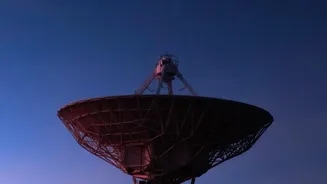
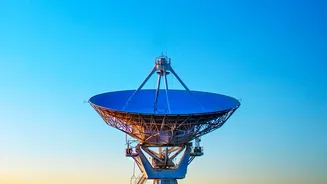
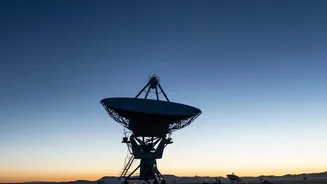
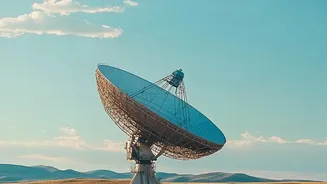
of Western Australia and consists of over 131,000 Christmas-tree-like antennas designed to capture low-frequency radio waves. The second, SKA-Mid, uses hundreds of large satellite-like dishes in South Africa's Karoo desert to detect mid-frequency signals. Construction officially began in late 2022, with the project steadily progressing toward full scientific operations expected to commence around 2028-2029. These locations were chosen for their extreme remoteness, far from the radio interference of cities, creating pristine conditions to hear the faintest cosmic murmurs.
The Power of Unprecedented Sensitivity
The SKA's strength lies in its immense scale and cutting-edge technology. The name itself comes from the original goal of creating a combined collecting area of one square kilometre. By connecting thousands of antennas over vast distances using a technique called interferometry, the SKA simulates a single, gigantic virtual telescope. This gives it unparalleled sensitivity and resolution. When complete, SKA-Low will be eight times more sensitive than the current best low-frequency radio telescope, while SKA-Mid will be nearly five times more sensitive than its closest counterpart. This leap in capability will allow astronomers to detect objects far fainter and more distant than ever before, producing images with up to 100 times the detail of current instruments. The sheer volume of data it will generate—estimated at around 710 petabytes per year, enough to fill 1.5 million laptops—is a testament to its power and presents a new frontier in 'Big Data' astronomy.
Answering the Universe's Biggest Questions
With this extraordinary power, the SKA is poised to tackle some of the most profound mysteries in science. One of its primary goals is to look back in time to the 'Cosmic Dawn', the era just after the Big Bang when the very first stars and galaxies began to form. By detecting the faint radio signals from neutral hydrogen gas that filled the early universe, astronomers hope to map this critical period of cosmic history. The SKA will also be a revolutionary tool for testing Einstein's theories of gravity by timing the signals from pulsars—rapidly spinning neutron stars—with extreme precision. Furthermore, it will investigate the nature of dark energy and dark matter, hunt for the origins of cosmic magnetism, and dramatically expand the search for complex molecules and potential biosignatures in space, bringing the search for extraterrestrial life into a new era.
India's Crucial Role in a Global Endeavour
The SKA is a massive international collaboration, bringing together more than a dozen countries, with India playing a foundational and critical role. India formally joined the SKA Observatory (SKAO) as a full member, committing ₹1,250 crore to the project's construction phase. Indian scientists and engineers, led by the National Centre for Radio Astrophysics (NCRA) in Pune, have been involved since the project's early days. A key contribution has been the development of the Telescope Manager, the complex software 'neural network' that will control and operate the entire telescope system. This places Indian expertise at the very heart of SKAO's operations. India's long and rich heritage in radio astronomy, including the pioneering Giant Metrewave Radio Telescope (GMRT), makes it a natural leader in this global pursuit of knowledge, ensuring the nation remains at the forefront of scientific discovery.