


What Are AI-Powered VR Labs?
Imagine strapping on a VR headset and, instead of seeing a game, you find yourself standing on the surface of Mars, ready to test the laws of gravity. This is the new reality of the advanced physics lab. At its core, this technology combines two powerful
tools. Virtual Reality (VR) creates immersive, 3D environments where students can conduct experiments that would be impossible, dangerous, or too expensive in the real world. The second layer, Predictive Artificial Intelligence (AI), acts as a hyper-intelligent lab assistant. It doesn't just run the simulation; it analyses a student's actions, predicts the outcomes of changing variables, and offers guided insights, personalising the learning journey for each user.
Visualising the Impossible
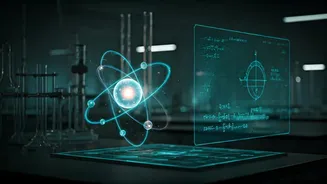
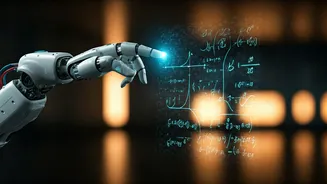
Traditional physics education often hits a wall when it comes to abstract concepts. How do you truly demonstrate Einstein’s theory of relativity or the bizarre behaviour of particles in quantum mechanics? You can write equations on a blackboard, but you can’t show a student what it feels like to travel near the speed of light and see time dilate. This is where VR models shine. Students can now virtually pilot a spaceship to observe length contraction firsthand. They can shrink down to the subatomic level to see electron orbitals not as static drawings, but as dynamic clouds of probability. These experiences build intuition, transforming physics from a subject of memorisation into one of deep, conceptual understanding. It’s the difference between reading a recipe and actually cooking the dish.
The AI ‘Lab Partner’
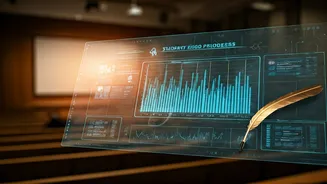
The 'predictive' aspect is what makes this technology truly transformative. In a traditional lab, a failed experiment can be a dead end. In an AI-powered VR lab, it’s a learning opportunity. For example, a student might be building a virtual circuit. If they make a mistake, the AI doesn’t just say 'wrong.' It might highlight the problematic component and ask, 'What do you predict will happen if you double the resistance here?' It encourages a hypothesis-driven approach, a cornerstone of the scientific method. This AI co-pilot can track a student’s progress, identify areas where they are struggling, and serve up tailored challenges or simpler explanations, creating a learning path that adapts in real-time to their individual needs.
A Fit for the Indian Classroom
This technology holds immense promise for the Indian education system. Many schools, particularly in rural areas, lack access to well-equipped physics labs. A single set of VR equipment could provide thousands of students with access to a world-class virtual laboratory, capable of running infinite experiments without any material cost or safety risk. This aligns perfectly with the goals of India’s National Education Policy (NEP) 2020, which stresses the importance of experiential learning and reducing rote memorisation. Pilot programmes in several Tier-1 city schools are already showing positive results, with students demonstrating higher engagement and a better grasp of complex topics. The potential to democratise access to high-quality science education is one of the most exciting aspects of this innovation.
The Challenges Ahead
Despite the enormous potential, widespread adoption faces hurdles. The primary barrier is cost. High-quality VR headsets and the powerful computers needed to run them are still expensive. Furthermore, teachers require specialised training to move from being instructors to facilitators in these new learning environments. They need to learn how to guide students through virtual experiments and integrate these digital experiences with the core curriculum. Finally, ensuring equitable access and bridging the digital divide will be crucial. Without a concerted effort from policymakers and educators, this transformative technology risks becoming a tool that widens, rather than closes, the gap between well-funded urban schools and their underserved rural counterparts.